
Solar Panel
BEESTE supplies folding and rigid solar panels from 100W to 400W, built for pairing with portable power stations. Panels use monocrystalline cells at 23% conversion efficiency, laminated with an ETFE surface, EVA encapsulant and a fibreglass backing board.
Folding or rigid
Folding panels are the travel format: they pack flat, survive repeated folding and carry a handle. Rigid glassboard panels suit fixed installs on roofs, sheds and off-grid cabins. Both use the same cell technology and the same 23% efficiency figure.
Connector and voltage matching
Output connectors can be specified as DC5521, DC7909, Anderson 30A, XT60 or MC4. The panel working voltage has to sit inside the power station MPPT window: a 100W panel runs at 20.5V, a 300W panel at 40V. Tell us which station you are pairing with and we will confirm the match.
Ingress and build
- IP68 rated junction and cable entry
- ETFE surface, EVA encapsulant, fibreglass backing
- 1.5 m cable as standard, length to order
- Integrated lamination, not surface-bonded film
Wholesale and OEM
Panel wattage, connector type, cable length, bag and carton printing can all be specified. Send your specification and we will confirm container loading with the quote.
Sizing a panel against a battery
Panel wattage is a peak figure measured under standard test conditions, not a promise of what the panel delivers on a roof in November. The working number is energy: panel watts multiplied by peak sun hours multiplied by a derate for heat, angle and surface losses. As a planning assumption, four to five peak sun hours covers most of Europe and North America across the year, and a derate of roughly 0.7 to 0.8 accounts for the gap between the label and reality.
That gives a simple test. A 1,000Wh battery that is expected to refill in one decent day needs something in the region of 250W to 350W of panel, not the 100W panel that often ships in a bundle. If the panel is undersized, the buyer will not notice in summer and will complain in winter, which is the most common support case in this category.
Cell type and surface material
- Monocrystalline cells are the default for folding panels at this scale. They give more output per square metre than polycrystalline, which matters because a folding panel is limited by how much area a person will carry.
- ETFE surface is the more durable laminate. It resists scratching and UV yellowing better than PET, and it is the difference between a panel that survives a season in a work truck and one that does not.
- Cell cutting and interconnection decide how the panel behaves when part of it is shaded. Ask how the strings are arranged, because a partly shaded panel with series strings can drop far more than the shaded area suggests.
- Junction box and bypass diodes are the parts that fail first in the field. They are rarely mentioned in listings and are worth asking about directly.
Where folding and rigid panels each belong
- Folding panels suit camping, overlanding, RV travel and emergency kits, where the panel is packed and moved. The trade-off is cell area and hinge wear.
- Rigid framed panels suit sheds, cabins, telecom cabinets, security posts and small off-grid installations, where the panel is mounted once and stays.
- Flexible panels suit curved surfaces such as van roofs and boat decks. They run hotter because they lack an air gap, so the derate is larger.
What to check before ordering
- Vmp and Imp, not just wattage. The panel has to sit inside the charge controller's input window. A 200W panel at 40V and a 200W panel at 18V are different products for different controllers.
- Open-circuit voltage at low temperature. Voc rises as temperature falls, and a cold morning can push a string past a controller's limit.
- Connector type and cable length. MC4, Anderson and barrel connectors are not interchangeable, and a two-metre cable is often too short in practice.
- Ingress rating. IP65 or better for outdoor use, with the rating applying to the junction box and not only to the laminate.
- Folded and unfolded dimensions plus weight. These decide whether the product sells as portable or as transportable.
Questions buyers ask us
Can a 200W panel charge a 2,000Wh power station in a day?
Only in good conditions. At four peak sun hours and a realistic derate, a 200W panel delivers roughly 600 to 650Wh over the day, so a 2,000Wh pack needs two to three good days or a larger array. Sizing the panel to the pack is where most bundle kits fall short.
Do panels need to match the brand of the power station?
No, they need to match the input window. Voltage range, connector type and current limit are what matter. Matching the brand only guarantees the plug fits.
What is the realistic efficiency of a folding panel?
Cell efficiency and system efficiency are different numbers. A panel built from cells rated around 22 percent will still deliver well under its nameplate at the terminals once temperature, angle and cable losses are counted. Quote the measured output at the connector, not the cell figure.
How should panels be packed for export?
Folding panels ship as general cargo rather than as dangerous goods, but the laminate and junction box are fragile in transit. Carton drop testing and corner protection are worth specifying, because the failure rate on returns is usually mechanical rather than electrical.
Matching a panel size to the job
- 100W folding. Day trips, phone and laptop charging, topping up a 300Wh class station. Light enough to carry in a backpack, which is the whole point of the size.
- 200W folding. The most common choice for a 500Wh to 1,000Wh station on a camping or overlanding trip. Still portable by one person.
- 300W folding. Week-long trips, RV house loads and small cabins, usually paired with a 1,000Wh to 1,500Wh pack.
- 400W folding or rigid. Off-grid sheds, telecom cabinets and emergency backup where the array stays put or moves by vehicle rather than by hand.
If a buyer cannot decide between two sizes, the honest answer is usually the larger panel paired with a smaller station, because charging time is what people complain about after the first month.
More reading
- solar generator manufacturers — How solar generator lines are built and compared.
- portable power station wholesale — How wholesale pricing is structured for panels and stations.
- portable power station manufacturer — How to audit the factory behind the product.
- All manufacturing guides

200W 4-Fold Portable Solar Panel
Model NO.:SP-4F200W
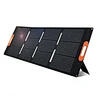
400W 4-Fold Portable Solar Panel
Model NO.:SP-4F400W
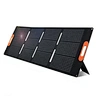
300W 4-Fold Portable Solar Panel
Model NO.:SP-4F300W
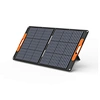
100W Dual-Fold Portable Solar Panel
Model NO.:SP-2F100W
- 1