Portable Power Station Wholesale: MOQ, Price Breaks and Payment
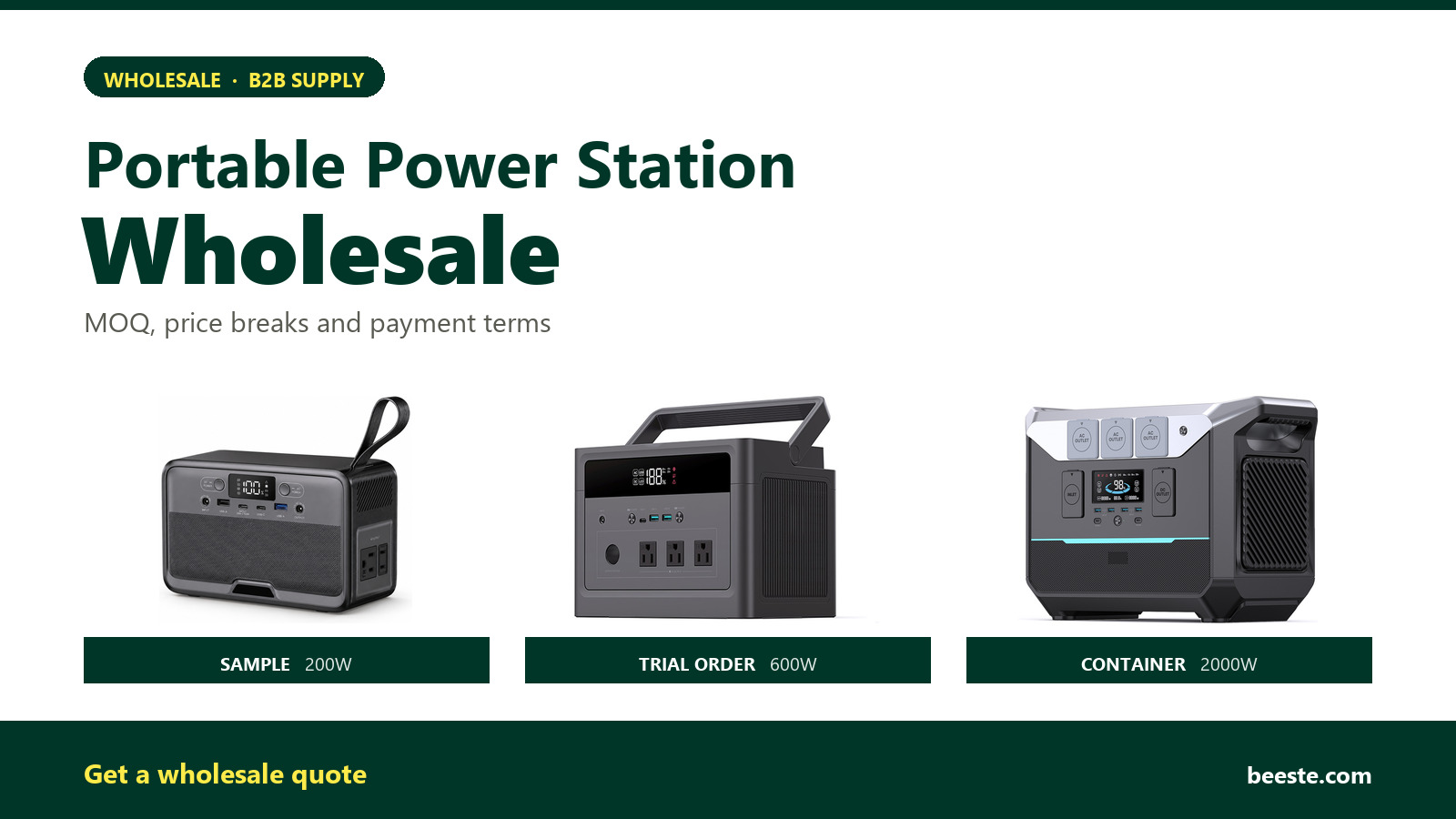
Buying portable power station wholesale is not a matter of finding the lowest unit price. It is a matter of matching an order size to a production run, agreeing what sits inside that price, and settling how and when money moves. Three levers drive every wholesale quote: the configuration you specify, the volume that justifies a dedicated run, and the payment structure both sides can live with. This page explains how those three work together, so you can compare quotes on equal terms instead of on the headline number alone.
If you are still choosing between suppliers rather than negotiating with one, read our guide to portable power station manufacturers first. This page assumes you have a shortlist and are now talking numbers.
What wholesale actually means for a power station
The word covers three different arrangements, and suppliers rarely say which one they are quoting. A single-model container buys depth: one SKU, one carton configuration, the lowest unit cost the factory can reach. A mixed-SKU container trades some of that saving for a spread of capacities, which is what most distributors need on a first order. A private label run adds tooling, print and packaging work on top of either. Browse the full portable power station range to see which capacities you would actually stock.
The three layers that set your unit price
A wholesale price is not one number. It is three layers stacked, and each layer moves independently. Ask any supplier to break their quote into these three parts and the comparison becomes honest.
| Layer | What it covers | What moves the number |
|---|---|---|
| Bare unit | Cells, BMS, inverter, housing, internal wiring | Cell grade, pack capacity, output configuration, inverter topology |
| Retail-ready | Manual, retail box, inserts, labels | Print method, number of languages, box structure and board grade |
| Loaded | Pallet, strapping, container loading plan | Pallet count per container, loading pattern, destination port |
Configuration is where most of the variance sits. A 600W 576Wh portable power station and a 1000W 960Wh portable power station may share a housing family and still differ by a whole price tier once output boards and pack configuration change. At the top of the range, a 2000W portable power station carries a heavier pack, a larger inverter and a different shipping class, which is why its freight line moves more than its unit line.
MOQ is a production run, not a gate
Most buyers treat the minimum order quantity as a wall. It is better understood as the smallest batch that covers a production changeover. Every model switch costs the factory a line stoppage, a stencil change and a packaging setup. Below that point, the setup cost has to be absorbed into fewer units, and the unit price rises faster than the quantity falls.
That gives you three ways to negotiate without asking for an exception. First, cut the configuration: one housing colour instead of four, one manual language instead of three, a standard carton instead of a custom one. Second, accept a scheduled slot: a factory filling a mixed container can often include a smaller run of your SKU alongside other work. Third, commit to a repeat: a two-order agreement at half the volume is usually easier to accept than a single order at the same total.
Payment terms and what they actually protect
Two structures dominate wholesale in this category. A deposit-and-balance arrangement, typically released against a pre-shipment inspection, protects the buyer's remaining exposure while giving the factory working capital for cells. A letter of credit protects both sides through a bank, at the cost of fees and paperwork, and is usually reserved for first orders or large values.
What matters when comparing offers is not the headline percentage but the trigger. Ask what event releases the balance: a fixed date, a photo, an inspection report, or a bill of lading. A term tied to a verifiable event is worth more than a slightly better percentage tied to nothing.
What to send for an accurate quote
A quote built on "a container of power stations" will be wrong in at least three places. Send these six items and the reply becomes a document you can compare:
- The capacity and output configuration you need, model by model
- Quantity per model, and whether one container or several
- Destination port, and whether you want FOB or delivered
- Packaging: standard carton, retail box, or private label
- Manual languages and any label content that needs approval
- Target ship window and whether the date is fixed or flexible
With those six, a factory can quote a real bill of materials instead of a range. Send your specification and we will reply with the three-layer breakdown above, so you can see exactly where the cost sits.
Frequently Asked Questions
What is the minimum order for a private label run?
It depends on how far the customisation goes. Changing a logo and a label is a different operation from a new housing mould. Send the specific changes and you will get a quantity that reflects the actual setup cost, rather than a generic number.
Can I mix several models in one container?
Yes, and most distributors do. Each model still carries its own minimum batch, because each one is a separate production run. The container is shared; the setup is not.
Do you quote FOB or delivered?
Both, on request. FOB keeps the freight under your control and is usually cheaper if you already have a forwarder. Delivered pricing is simpler to compare but hides the freight line, so ask for the breakdown either way.
How long does a wholesale quote take?
A standard configuration takes a working day. A private label quote needs packaging and print costing first, so allow longer, and expect a proof before the number is final.
Next Step
Send the six items above, or start with the two you already know. A partial brief with a clear destination and quantity is enough to open a real conversation. Request a wholesale quote and ask for the three-layer breakdown — it is the fastest way to tell whether two offers are actually comparable.
Related reading
- portable power station manufacturers — How a real factory differs from a trading company in capability and accountability. Read
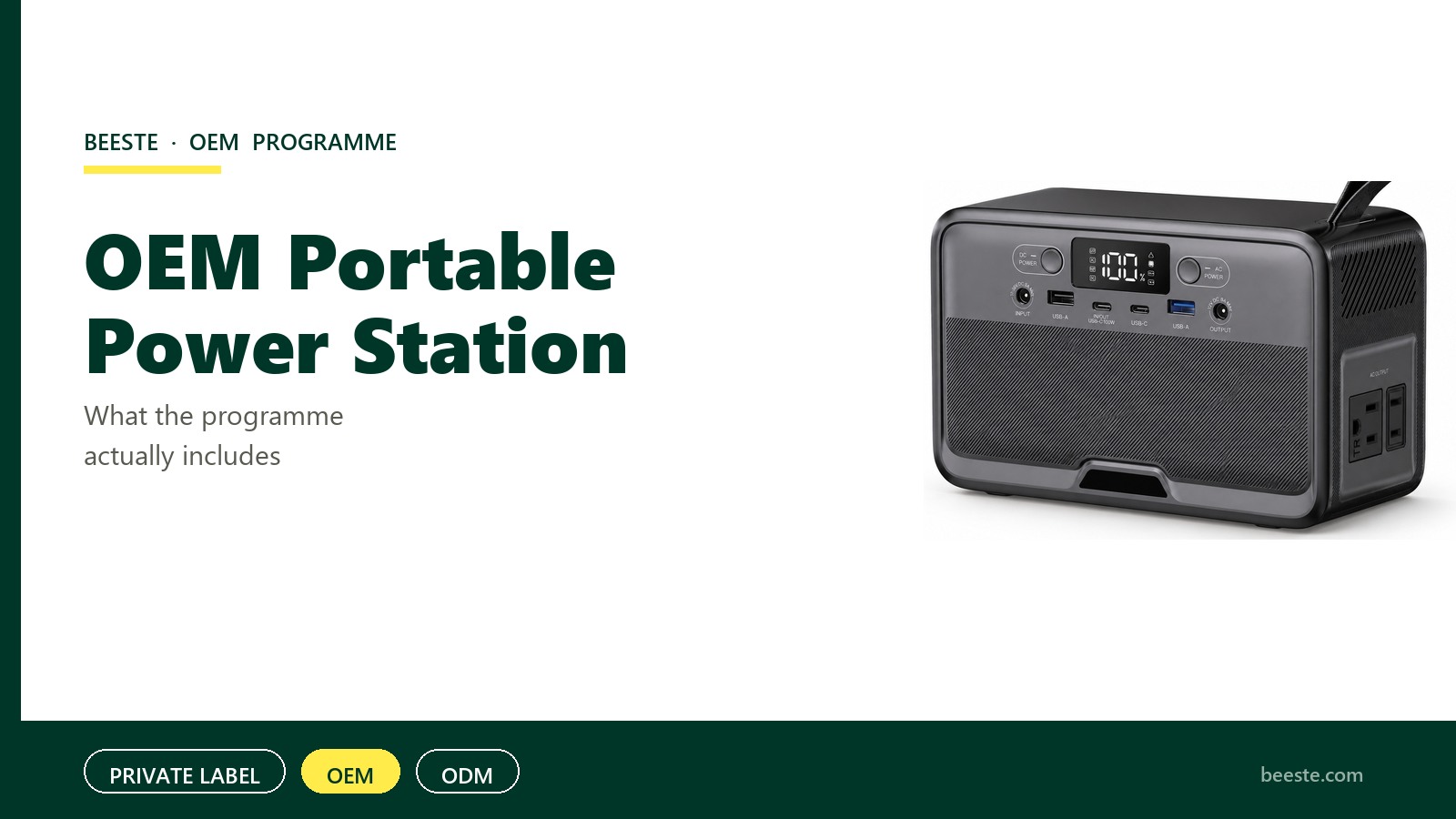
- OEM portable power station — What an OEM programme actually covers, from tooling and firmware to packaging. Read
- portable power station supplier — How a new brand should screen suppliers before placing a first order. Read
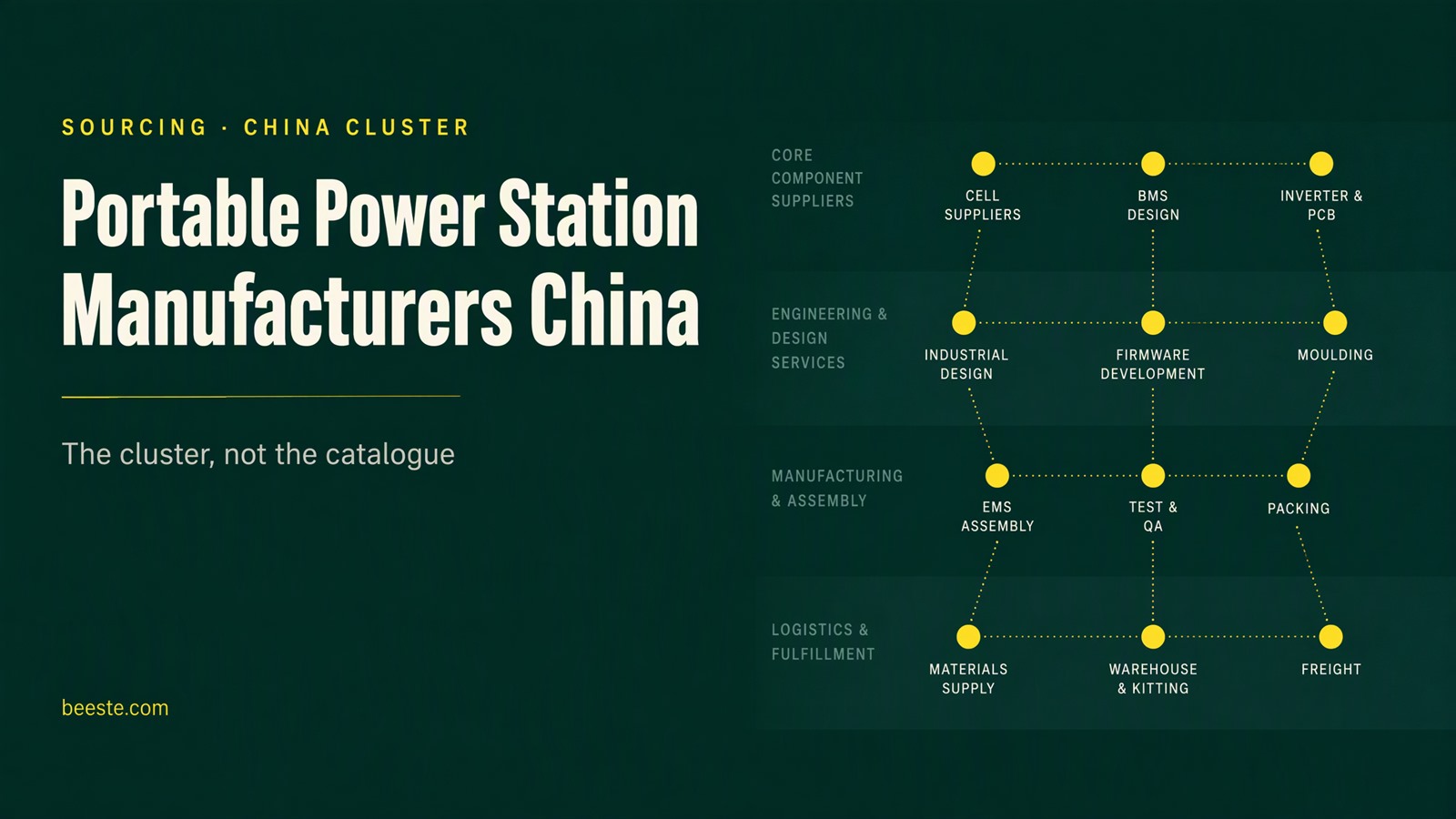
Portable Power Station Manufacturers China: The Cluster, Not the Catalogue
Certifications and Compliance
Related Article