OEM Portable Power Station: What the Programme Actually Includes
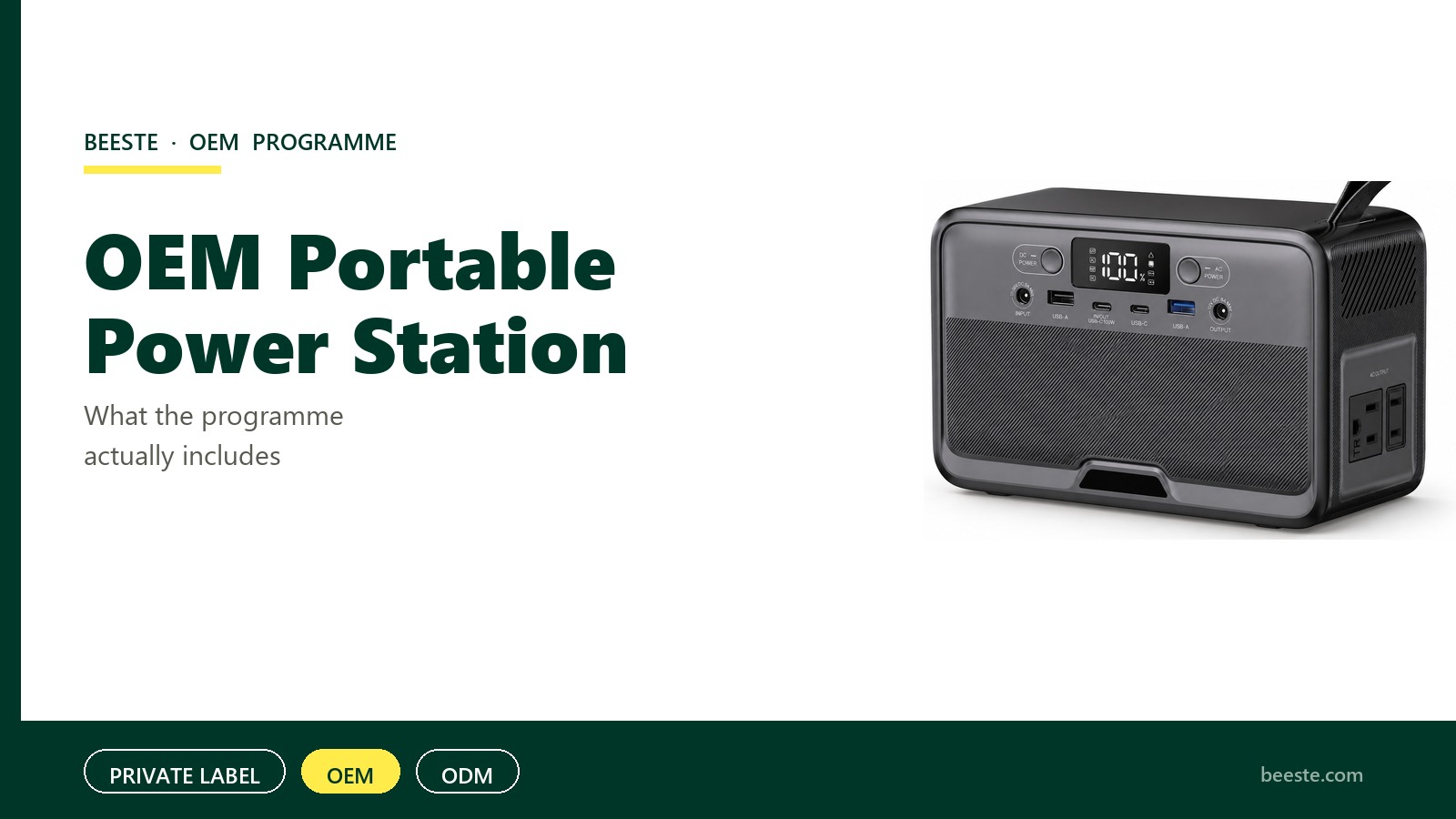
An OEM portable power station programme is not a logo service. It is a manufacturing arrangement in which the unit is built to your specification, tested against your acceptance criteria, documented in your name and packed for your channel. That definition matters, because most quotations that arrive under the word “OEM” are actually private label: the same finished unit, a different silkscreen, your carton. This article sets out what a genuine programme covers, where the cost actually sits, and what to demand in writing before you commit tooling money.
Three labels, three different deals
The words are used interchangeably in supplier emails. They describe very different levels of change, and they carry very different commitments from the factory.
| Model | What changes | What stays the factory's | Who owns the design file |
|---|---|---|---|
| Private label | Logo, silkscreen, carton artwork | Housing, BMS, inverter, firmware | Factory |
| OEM | Housing or tooling, port layout, firmware behaviour, packaging, documents | Cell supply and production process | Usually the buyer, by contract |
| ODM | Nothing — you select an existing design, then brand it | Everything, including the design itself | Factory |
If a supplier describes all three as “OEM”, you are not talking to someone who has run a programme. The practical difference shows up on the invoice: only one of these three involves tooling, and only one involves a design file you can take elsewhere.
What a full programme actually includes
A complete OEM portable power station programme touches six things. They are listed below in the order they usually go wrong.
A housing and tooling decision. Either you take an existing shell — cheaper, faster, and the tooling is not yours — or you pay for a mould and own it. Ask who holds the tool and what happens to it if you move. The answer should be in the contract, not in a chat message.
Port configuration. This is where buyers usually get more value than they expect. Changing a 30 W USB–C to 100 W, adding a second DC output, or removing a port to hit a price point are all engineering decisions with a real cost, not catalogue options. A factory that can tell you which changes cost money and which are free is a factory that has done this before — the same logic applies from a 200W portable power station up to a 2000W portable power station.
Firmware and BMS behaviour. Protection thresholds, fan curve, display behaviour, charge priority. If the firmware is not the factory's own, none of this is negotiable and your programme has a ceiling.
Packaging and documentation. Retail carton, insert, manual, and the shipping marks your forwarder needs. The manual is the part buyers underestimate: it has to match the unit you actually built, in the languages you actually sell in.
Certification in your name. Reports are issued to a named applicant for a named configuration. If the report stays with the factory, you are borrowing compliance rather than owning it — and a change of housing usually means a new test anyway.
Acceptance criteria and QC records. Agree the final-test list before the first batch, not after. Ask what happens to a unit that fails, and who signs the release.
Where the cost actually sits
Three costs drive an OEM quote, and they move independently.
Tooling is a one-off and it is yours or it is not. Amortised over a small first order it looks expensive; amortised over a year of production it is noise. Ask for the amortisation schedule rather than the headline figure.
Certification is per configuration, not per product family. Change the housing or the inverter board and the file usually has to be renewed. This is the single most common surprise in the second year of a programme.
Minimum order quantity is a consequence, not a policy. It is derived from cell purchasing tiers, tooling setup time and test-batch size. When a supplier quotes an MOQ without explaining which of the three drives it, the number is a negotiating position rather than a cost.
What to ask for before you sign
Put these in one email and keep the reply. It becomes the specification you measure the first batch against.
1. Which parts of this unit are made in your building, and which are bought in?
2. Who owns the tooling, and what is the transfer condition?
3. Which firmware functions can I change without a new board?
4. Is the certification report applicant the factory or me?
5. What is the final-test list, and can I add three items to it?
6. What is the MOQ built from — cells, tooling or test batch?
7. What is the change-order process after the first batch ships?
8. Can I see a unit from the same platform at a different size to judge consistency? A 600W 576Wh portable power station next to a larger model tells you more about build discipline than any brochure.
FAQ: what buyers ask next
Can I start with private label and move to OEM later?
Yes, and many brands do. The risk is that the housing and firmware you branded are not yours, so moving to a full OEM portable power station programme means a new tool and often new testing. If you expect to move, negotiate the design-file ownership at the start, while you still have leverage.
How long does a programme take?
It depends almost entirely on the tooling decision. Reusing an existing shell is a matter of weeks; a new mould adds design, trial, and a certification cycle on top. Ask for the schedule broken into those three stages rather than one number.
Do I have to buy the cells from the factory?
Usually yes, because the pack, the BMS and the test record are validated together. If you want a nominated cell brand, raise it early — it changes the test file and sometimes the MOQ.
What should the contract cover that the quote does not?
Tooling ownership and transfer, design-file ownership, who pays for re-testing after a change, and the acceptance criteria for each batch. Those four clauses decide what the relationship looks like in year two.
We build portable power stations and LiFePO4 packs and run OEM programmes on our own line. If you want to test how concrete the answers are, start from the portable power stations range and pick a platform to interrogate. Contact us with the eight questions above and we will reply in writing, including the parts we would have to quote rather than answer.
Portable Power Station Manufacturers: How to Tell a Factory From a Trading Company
Related Article