Portable Power Station Manufacturers China: The Cluster, Not the Catalogue
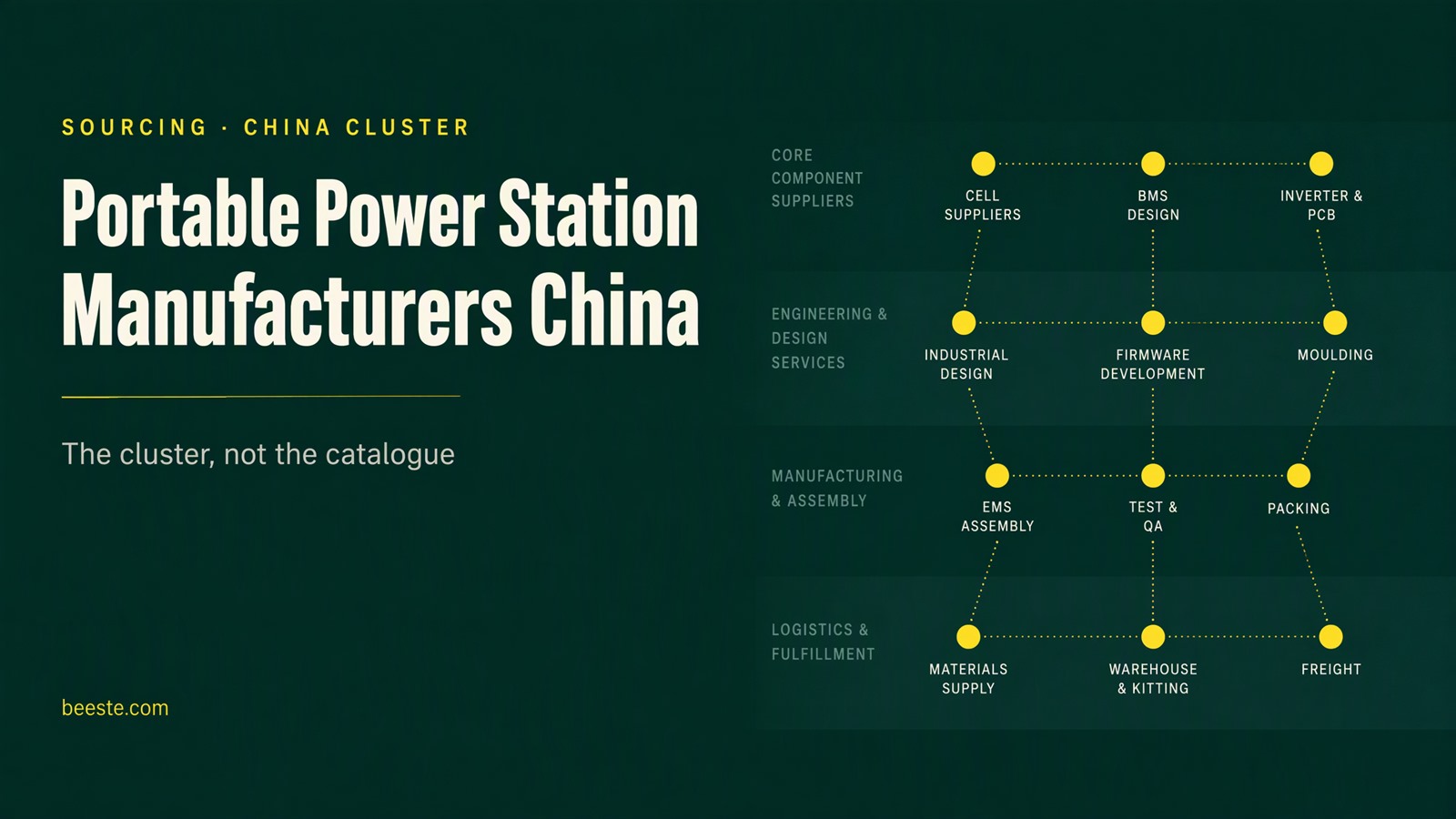
The reason portable power station manufacturers china has become a single sourcing destination is not labour cost. It is that cell distribution, BMS design, inverter supply, sheet metal, injection moulding, test equipment and a container port all sit inside roughly an hour of each other. That geography is what lets a spec change — a different cell, a bigger inverter, an extra output — move from drawing to sample in weeks instead of quarters. A catalogue can show you forty products. Only a member of the cluster can tell you which cell, which BMS and which inverter sits inside each one, and swap them on request. BEESTE builds in Shenzhen, inside that radius.
What the cluster actually contains
Buyers often treat "China" as one supplier. In practice a portable power station passes through six distinct tiers, and each tier is a separate industry with its own lead time and its own failure mode.
- Cell supply. LiFePO4 prismatic and cylindrical cells are bought on allocation, not from a shelf. The cell brand and grade decide cycle life more than any other single component.
- BMS design. The protection board is firmware as much as hardware. Whoever owns the firmware owns the behaviour at low temperature, at high current, and when a cell drifts.
- Inverter and charger stage. AC output quality, surge headroom and charge current all come from this board. It is the part most often bought in rather than designed.
- Enclosure and tooling. Injection moulds and sheet metal determine drop performance, heat path and — commercially — who pays for the tool.
- Assembly and test. Ageing racks, capacity grading and hipot testing are what separate a line from a workbench.
- Documentation and logistics. UN38.3 reports, MSDS, dangerous goods packing and a booking at the port decide whether the goods actually fly.
A company that only performs the last two tiers is an assembler. A company that owns the middle two is a manufacturer in the sense that matters to a brand: it can be held responsible for how the product behaves.
Why the search "manufacturers China" returns so many catalogues
Most pages ranking for portable power station manufacturers china are trading companies with a well-built product grid. A trader cannot answer the four questions a brand needs answered before signing a mould.
Ask for the BMS topology and who writes the firmware. Ask which SMT line the board runs on and what the hourly rate is. Ask for a change order on an existing SKU — a different output configuration, a different cell — and watch how long the quote takes. Ask for a factory walkthrough where the model numbers on the fixtures match the model numbers on the quote. A factory answers these in a call. A catalogue answers them with a brochure.
Capacity bands and who buys them
The range runs from pocket units to whole-home backup. Each band has a different buyer, a different certification path and a different failure mode worth verifying before the first sample.
| Band | Typical build | Primary buyer | What to verify first |
|---|---|---|---|
| 100–350W | 90–300Wh, one or two AC outlets, USB-C PD | Outdoor retail, promotional programmes | Weight and pack size claims; whether surge is sustained or nominal |
| 500–600W | 280–580Wh, LiFePO4, MPPT input | Camping and overlanding brands, distributors | Real charge time from solar, not the ideal number |
| 1000W | 580–960Wh, 2000W surge class | Amazon and independent-store sellers | Whether the inverter is in-house or bought, and its derating |
| 1500–2000W | 1150–2100Wh, 3000W surge class | Home backup, job site, tender supply | Surge duration, not just peak watts; thermal behaviour at full load |
Two examples from our own line make the point. The 2000W portable power station carries 2073Wh behind a 2000W continuous stage with a 3000W surge, which is the band where surge duration starts mattering more than the peak figure printed on the box. The 1500W portable power station pairs a 1152Wh pack with the same 3000W surge class, and is the unit most often specified for job-site and small-office backup where the load is a tool, not a laptop.
Documentation that has to travel with the goods
Cells are class 9 dangerous goods. Nothing ships by air without a UN38.3 test summary and an MSDS, and the airline will check that the report names the exact cell and the exact pack model. On the electrical side, the EU market expects CE marking with a RoHS declaration, and the US market expects FCC for the wireless and charger stages. Where a safety standard is cited, it should be the current one — IEC 62368-1 has replaced IEC 60950-1, and EN 55032 has replaced EN 55022.
The practical test is simple: ask for the report number and the model it names. A report that names a different model number than the one on your purchase order is not your report.
What changes when a catalogue order becomes a programme
Moving from buying stock to running a private label programme changes five things at once: tooling ownership, firmware behaviour, packaging, spare parts ratio and lead time. On firmware, the question is whether the low-temperature cutoff and output priority can be tuned. On packaging, it is who owns the artwork files and who pays for a plate change.
A 500W portable power station is a useful reference point here: 288Wh, 100W USB-C PD, 150W AC charging and an 80W solar input. Those four numbers are the ones a private label buyer actually specifies, and every one of them is a line on a change order rather than a fixed feature of a catalogue page.
If you are still mapping the category, the pillar page on portable power station manufacturers sets out the factory-versus-trader distinction in more detail, and the portable power station category page lists the full range from 100W to 2000W.
Questions buyers ask before the first sample
Are Chinese manufacturers actually cheaper?
On unit cost, usually yes, though the gap narrows once freight, duty and a failed batch are counted. The stronger argument is iteration speed: a spec change that takes a quarter elsewhere takes weeks here.
How do I confirm a supplier is a real factory?
Ask for the BMS topology, the inverter supplier and a change order quote on an existing model. A factory answers specifically and quickly. A trader forwards the question and returns with a brochure.
What is a realistic minimum order?
It depends on what changes. A stock model with a different logo is a small order; a new enclosure needs a mould, and the tool cost, not the unit count, sets the real floor. Ask for it separately.
Which documents do I need for the EU and the US?
For air freight, UN38.3 and MSDS are non-negotiable. For the EU, CE with a RoHS declaration. For the US, FCC for the charger and wireless stages. Ask for the report numbers and confirm they name your model.
Next step
If you are shortlisting portable power station manufacturers china for a programme rather than a one-off purchase, send the load profile and target market and we will come back with the band, documents and change-order options that fit. Contact BEESTE to start that conversation.
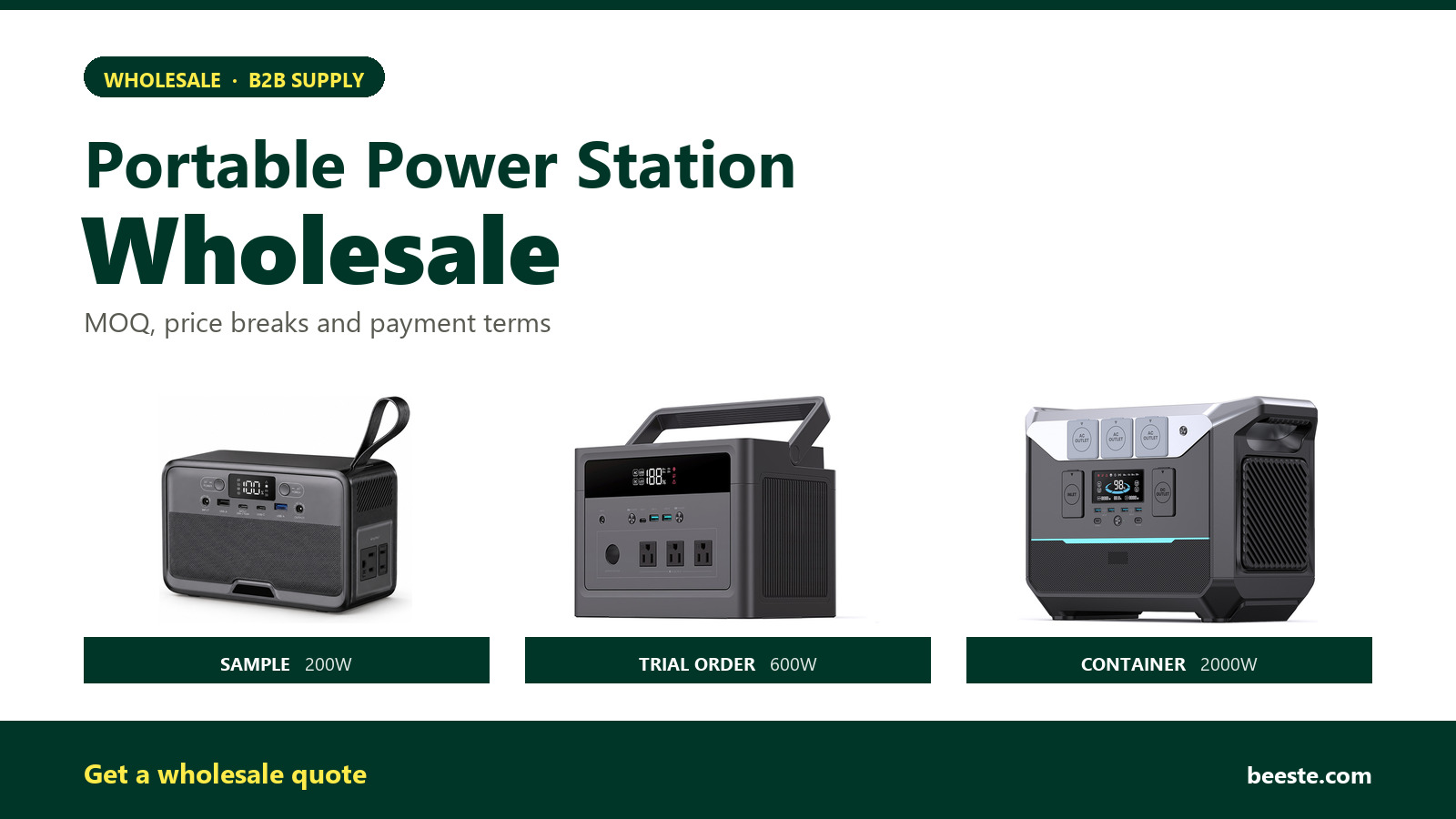
Portable Power Station Wholesale: MOQ, Price Breaks and Payment
Related Article