NEO1800 Pro 1800W/1382Wh Portable Power Station for Home Outages
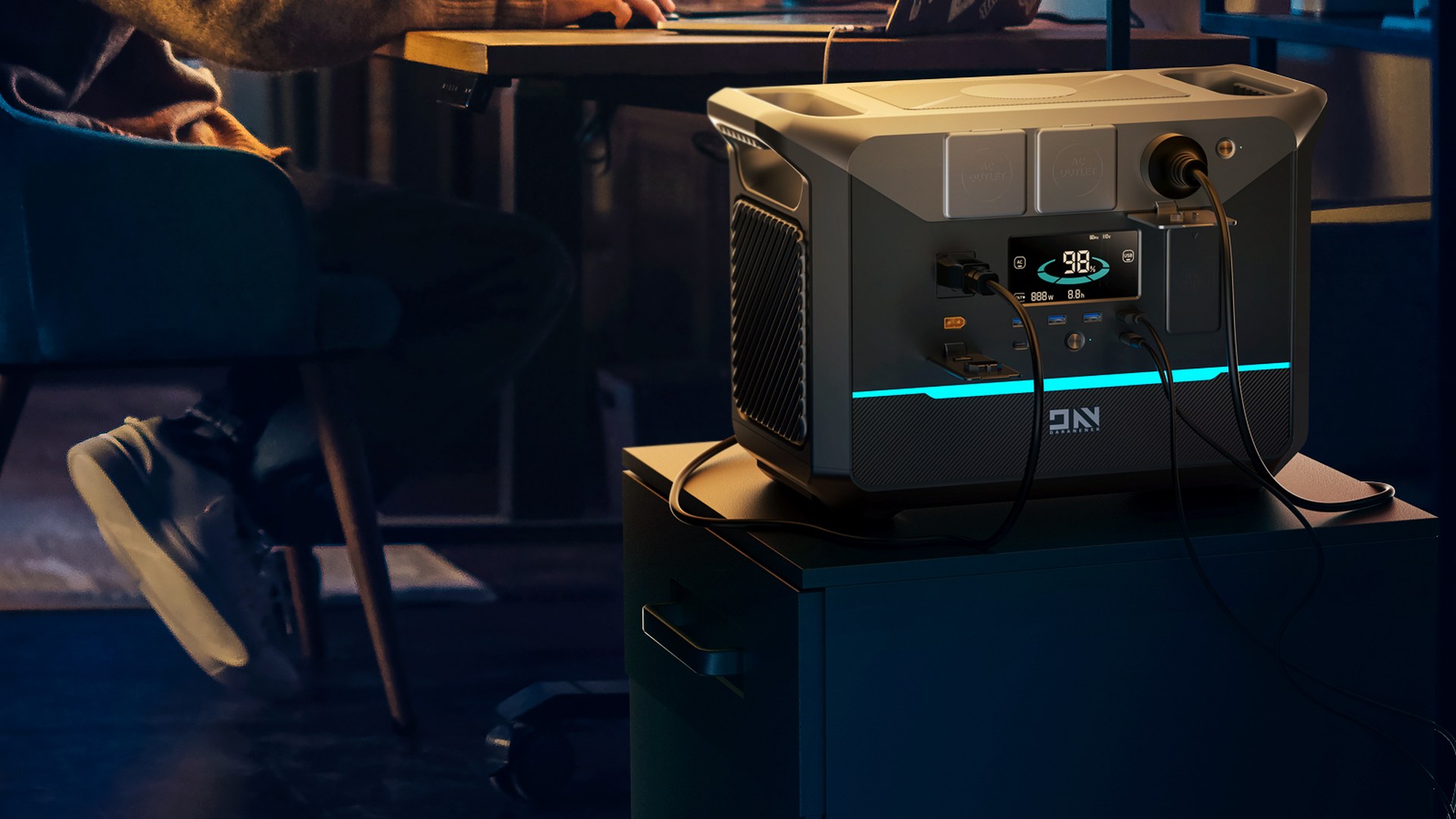
The BEESTE NEO1800 Pro is an 1800W portable power station with a 1382.4Wh LiFePO4 battery, 18.4 kg (40.48 lb) of body weight, three 230V AC outlets, four USB-A ports, two USB-C ports rated at 100W and 27W, and a 12V DC output rated to 120W. It holds 1800W continuously, delivers 3600W for three seconds, and produces a pure sine wave with a UPS transfer time under 15 milliseconds.
Those five numbers — continuous power, energy, peak, waveform and transfer time — decide whether a station is backup equipment or an expensive torch. This article works from the manufacturer's Rev A0 specification sheet for the 230V model rather than from marketing copy, and it sets out what the NEO1800 Pro will do in an outage as carefully as what it will not.
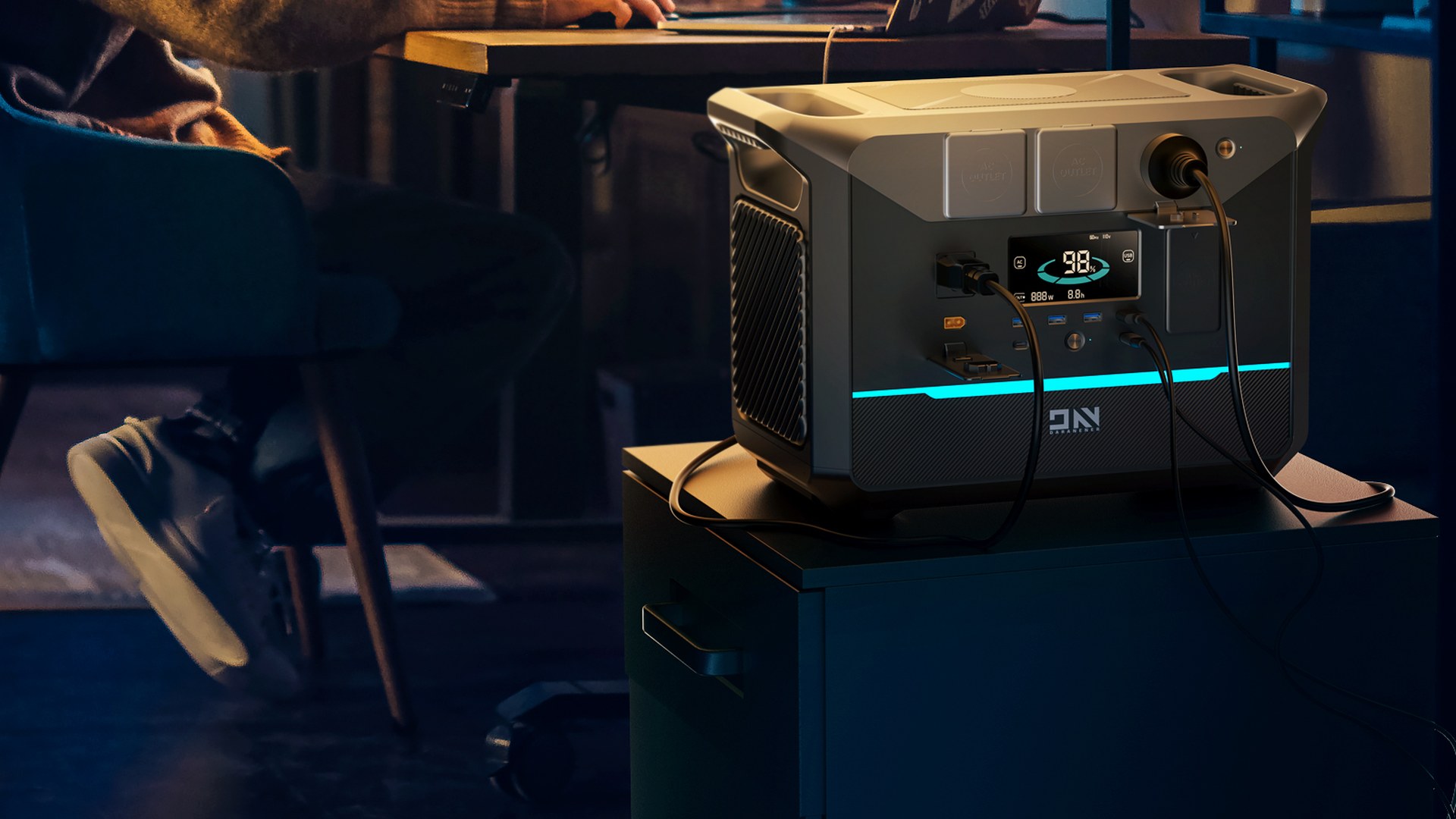
NEO1800 Pro — 1800W continuous, 3600W for three seconds, 1382.4Wh LiFePO4, 18.4 kg.
Why 1800W and 1382.4Wh only make sense together
An 1800W inverter on a 1382.4Wh battery is a ratio decision: 1.3W of continuous output for every watt-hour of storage. Read alone, 1800W says the unit can start a compressor; read alone, 1382.4Wh says it can run a router for two days. Together they say something more useful and less flattering — this station carries medium loads for hours and heavy loads for minutes.
The arithmetic fits on the back of the sheet. About 85% of nominal energy reaches the AC sockets after inversion, so plan on roughly 1175Wh of usable AC energy: 39 minutes at the full 1800W, 3.9 hours at 300W, 7.8 hours at 150W, which is a fridge cycling on a warm evening. None of those figures is a measurement, which is exactly why each can be checked.
The other common design pairs a 1000W inverter with a similar pack: longer at the top of its range, but it cannot start a 1600W appliance at all and will trip on an 800W pump's start-up current. The NEO1800 Pro takes the opposite side of that trade on purpose. Which side is right depends on whether your outage list contains a motor.
NEO1800 Pro specifications in full
Every figure below is taken from the Rev A0 specification sheet for the 230V model, dated 2026-03-02. Nothing in this table is an estimate.
| Item | Specification |
|---|---|
| Model | NEO1800 Pro (internal designation NEO1800) |
| Rated AC output | 1800W continuous |
| Peak output | 3600W for 3 seconds |
| Nominal energy | 1382.4Wh |
| Cells | Prismatic 27Ah LiFePO4, 1P16S, 51.2V nominal |
| Cycle life | At least 3000 cycles to 80% of original capacity (80% DOD, 1C charge and discharge) |
| AC input (charging) | 230VAC (200–240V), 1000W maximum charging power |
| Solar input (XT60) | 11–80V, 10A maximum, 800W maximum |
| AC outlets | 3 (230V model) |
| USB outputs | 4× USB-A (two at 18W, two at 12W), 2× USB-C (100W and 27W) |
| DC output | 12V⎓10A, 120W |
| Output waveform | Pure sine wave |
| UPS transfer time | Under 15ms |
| Inverter efficiency | At least 90% at full load |
| No-load consumption | Under 20W with the inverter on, under 5W in standby |
| Ingress protection | IP21 |
| Noise | 50dB or lower |
| Charging temperature | 0–45°C |
| Discharging temperature | −10–45°C |
| Dimensions | 43.9 × 23.6 × 29.6 cm |
| Net weight | 18.4 kg / 40.48 lb |
| Light | 3W LED: steady, medium, strobe, SOS |
| Display | LED segment display: AC voltage, frequency, power and runtime; DC power and runtime; charge power and runtime; fault codes |
The 1382.4Wh figure is not rounded. Sixteen cells in series at 3.2V nominal give 51.2V, and 51.2V × 27Ah is 1382.4Wh — the decimal exists because the total comes from a cell count, not a marketing target.
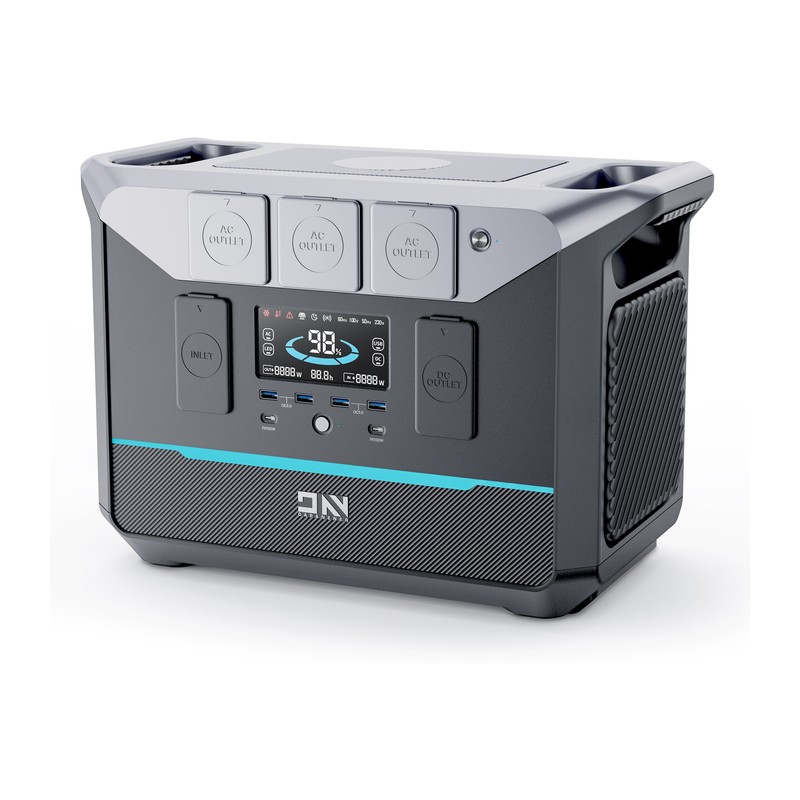
Weight follows from the same arithmetic: 1382.4Wh in an 18.4 kg body is about 75Wh per kilogram at system level, normal for LiFePO4 with an integrated inverter and enclosure. It is a two-handed lift onto a shelf.
Front panel: three AC outlets, four USB-A and two USB-C ports, with the DC output and AC inlet on the sides.
Ports: what can run at the same time
Six USB ports and three AC outlets sound like more capacity than the inverter has. They are not: the USB and 12V outputs run from DC-DC converters, not the inverter, so they do not consume the 1800W AC budget — though they do draw from the same battery and shorten runtime.
| Output | Count | Rating | Practical use |
|---|---|---|---|
| AC outlet (230V, 50Hz) | 3 | 1800W shared across all three | Appliances, tools, chargers |
| USB-C1 | 1 | 100W max, PD | Laptop at full speed without the AC brick |
| USB-C2 | 1 | 27W max | Phone, tablet, headphones |
| USB-A1 / A2 | 2 | 18W max each, QC3.0 | Phones, small accessories |
| USB-A3 / A4 | 2 | 12W max each | Low-draw devices, sensors, radios |
| DC output | 1 | 12V⎓10A, 120W | 12V fridge, router, radio gear |
| LED light | 1 | 3W | Room lighting during an outage |
The 100W USB-C port changes daily behaviour: a laptop charged through USB-C avoids the inverter entirely, so the same stored energy goes further and an AC outlet stays free for something that needs mains voltage. A realistic simultaneous load — a 1200W appliance on AC, a laptop at 100W and two phones at 18W — comes to about 1336W, inside the rating. Add a second high-draw appliance and overload protection trips, which is correct behaviour rather than a fault.
Runtime by load, stated in hours
Runtime is arithmetic, not opinion: usable AC energy divided by the load. With 1382.4Wh at 0.85 conversion, that divisor is 1175Wh.
| Load | Typical device | Estimated runtime |
|---|---|---|
| 20W | ONT plus router | About 58 hours |
| 40W | LED lighting plus router | About 29 hours |
| 60W | CPAP, no heated humidifier | About 19.5 hours |
| 100W | Projector or fan | About 11.7 hours |
| 150W | Household fridge, duty-cycle average | About 7.8 hours |
| 300W | Desktop plus monitor | About 3.9 hours |
| 500W | Coffee machine, brew phase | About 2.3 hours |
| 800W | Microwave on medium | About 1.5 hours |
| 1800W | Full load, such as a heater plus a high-draw appliance | About 39 minutes |
Three qualifications keep this table honest. Resistive loads sit close to these figures; motor loads draw start-up current several times their running rating and run on a duty cycle, so a fridge's real consumption sits well below its nameplate. Mixed loads add up, so runtime comes from their sum, not the largest item. And these are values calculated from a 1175Wh divisor, not bench measurements: a cold battery delivers less.
UPS behaviour: under 15ms, and what that number does not cover
Connected to mains with equipment plugged into it, the NEO1800 Pro behaves as a UPS: when mains fails, the inverter takes over in under 15 milliseconds. That is fast enough that a router, an ONT, a NAS or a desktop does not reboot, because their power supplies hold voltage across a gap of that length.
Fifteen milliseconds is also not zero. An online double-conversion UPS transfers in 0ms by design, and some laboratory instruments, imaging equipment and precision medical devices state a transfer requirement that a line-interactive design does not meet. For a CPAP blower, network gear and consumer electronics, 15ms sits comfortably inside tolerance; for a device with a stated 0ms requirement, it does not.
The second limit is scope. The UPS function protects what is plugged into the station and nothing else: it does not back-feed a house circuit. For a router, that means moving its plug; for a hard-wired appliance, the station is not the answer.
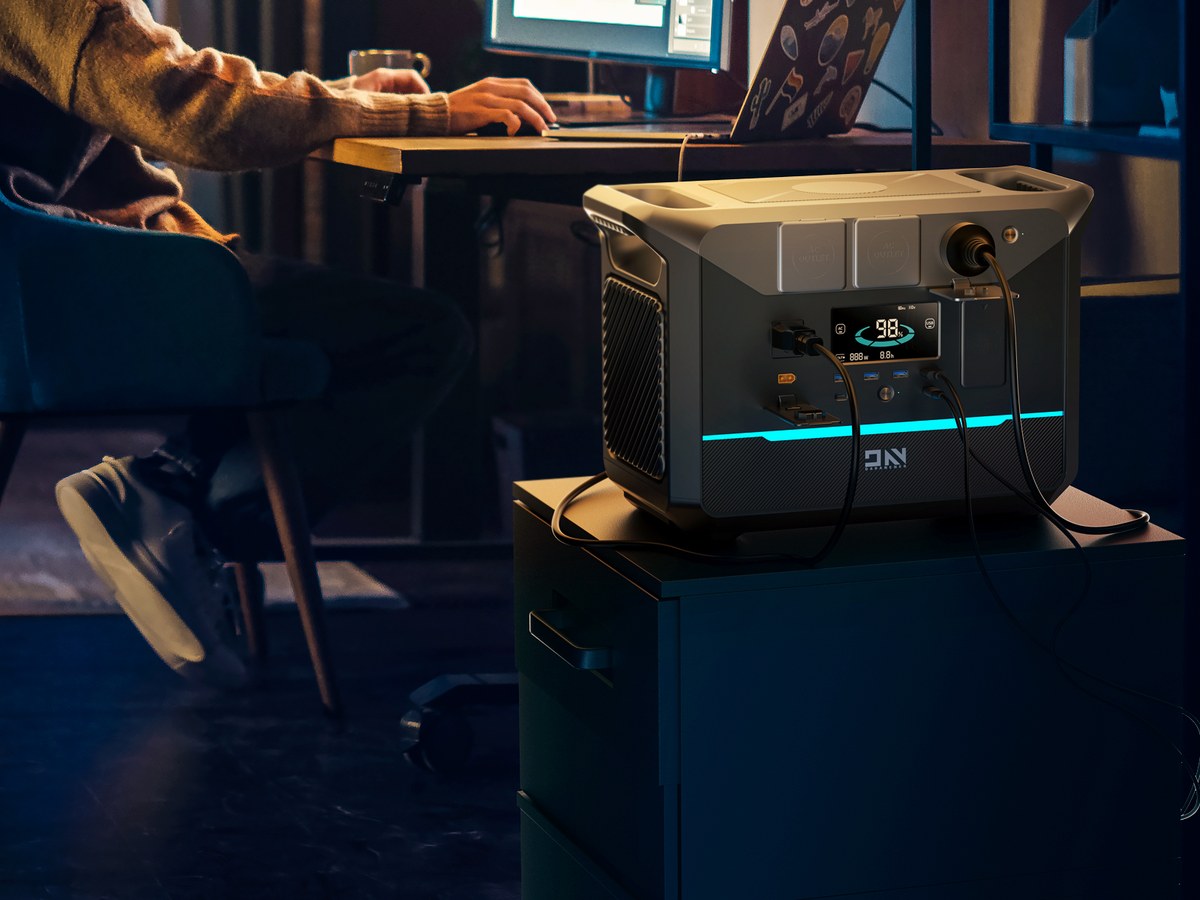
Outage use: router, ONT and lighting run for hours at low draw; the station transfers in under 15ms.
What the NEO1800 Pro runs well
An 1800W portable power station for home backup earns its place on four load profiles. Anything outside them is a different purchase, not a bigger one.
A home outage evening. A router and ONT draw about 20W, two LED lamps about 40W, and a fridge cycling at an average of 150W brings the total to roughly 210W. That is about 5.6 hours, enough to carry an evening and a fridge's cooling cycle without opening the door and losing the cold. Run the fridge alone and it stretches to 7.8 hours.
A night on CPAP. At 60W with the humidifier off, the unit runs about 19.5 hours through the AC outlet — two full nights with margin. This is the load profile where the 1382.4Wh pack is comfortably oversized rather than marginal, and where the 1800W inverter is irrelevant: the purchase decision here is energy, not power.
A desk or a small workshop. A desktop and monitor at 300W run about 3.9 hours, which covers a working afternoon through a scheduled outage. A 500W coffee machine runs about 2.3 hours of brew phases, and an 800W microwave about 1.5 hours of cooking — the kind of load list that a 1000W station cannot serve at all.
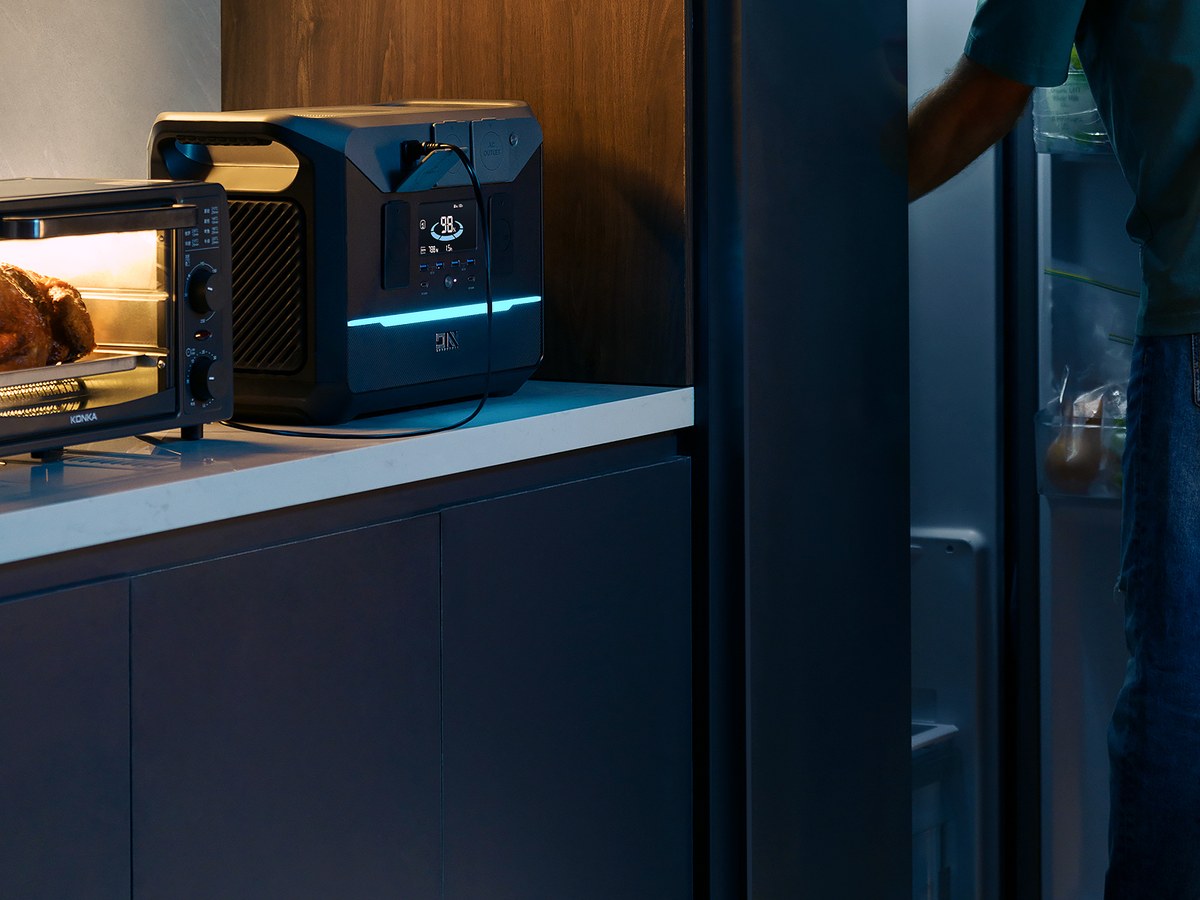
Field work and events. The 3W LED with strobe and SOS, the pure sine wave output and the 50dB noise floor make the unit usable indoors and at a stall, and the 12V DC output runs lighting and radio gear without touching the inverter. At 18.4 kg it is a vehicle-borne unit, not a backpack one.
Kitchen and living-room loads: fridge, coffee machine and lighting on one 1382.4Wh pack.
Charging: 1000W from the wall, 800W from solar, and a slow vehicle input
Three inputs, three very different speeds. The wall charger is the fast path, solar is the off-grid path, and the vehicle socket is a trickle that keeps the pack topped up rather than refilling it.
| Method | Input | Maximum power | Time to full |
|---|---|---|---|
| AC mains | 230VAC, 200–240V, 50Hz | 1000W | About 1.4 hours of bulk charge, about 1.5 hours to full |
| Solar (XT60) | 11–80V, 10A | 800W | Under 2 hours at full array output, 2–3 hours in practice |
| 12V vehicle socket via XT60 | About 13.8V | About 138W, capped by the 10A input limit | About ten hours of driving |
The AC figure is deterministic: 1382.4Wh divided by 1000W is 1.38 hours, and the final part runs at lower current as the pack fills, so 1.5 hours is the realistic expectation from empty. A 200–240V window covers UK and EU mains without a transformer, which matters if one SKU ships to both markets.
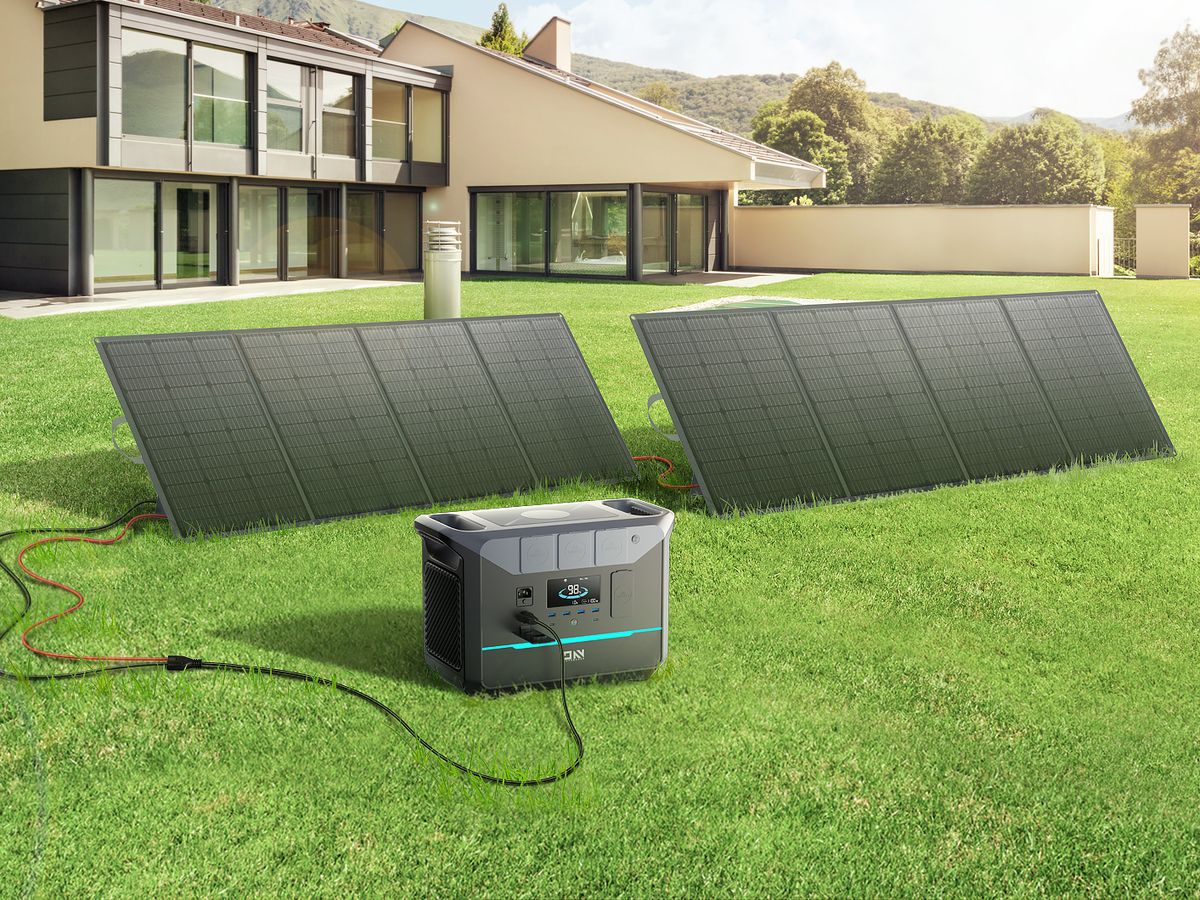
On solar, plan against the 800W ceiling: an 800W array at good incidence refills the pack in under two hours, while a 400W array still works at roughly twice the time. Panel voltage must sit inside the 11–80V window — a single 12V-nominal panel often falls below it, and two in series is the usual fix. The vehicle path is the one most often overestimated: a 12V socket at about 13.8V fits that window, but the 10A limit caps the rate near 138W, so a full recharge takes most of a long drive. Confirm the cable with the supplier before relying on it.
Solar charging through the XT60 input: 11–80V, 10A, 800W maximum.
Load compatibility, and the three-second peak trap
An 1800W continuous rating excludes the appliances people most want during an outage. Heating loads are the problem: anything that turns electricity into heat draws more than the inverter can sustain, and no amount of peak rating changes that. The table below separates the loads that fit from the ones that do not.
| Load | Typical continuous draw | Verdict |
|---|---|---|
| Refrigerator or freezer | 100–200W average, higher on start-up | Supported; start-up surge is the real test |
| Sump or transfer pump | 400–800W | Marginal; depends on start-up current |
| Microwave oven | About 800W | Supported, about 1.5 hours |
| Desktop and monitor | About 300W | Supported, about 3.9 hours |
| Circular saw or similar power tool | 1200–1800W | Marginal; surge-dependent and short-duty |
| Kettle, iron, hair dryer | Usually above 1800W | Not supported |
| Air conditioner, compressor type | 900W and up, plus a large surge | Not supported |
| Electric water heater | Far above 1800W | Not supported |
| Induction cooktop | Above 1800W in normal use | Not supported |
The peak figure needs a warning attached. 3600W is available for three seconds, which covers motor start-up — a compressor or pump briefly drawing three to five times its running current. It is not a licence to run a 3000W appliance: sustained draw above 1800W trips protection.
Work the numbers before buying. An 800W pump starting at four times its rating asks for 3200W, inside the window but only just, and a second start while the first settles will not be covered. A fridge at 150W average is comfortable; a 2000W heater is a different product category.
LiFePO4, 3000 cycles, and what that means in years
At least 3000 cycles to 80% of original capacity, at 80% depth of discharge and 1C, is the specification — and the cycle count is the least interesting part of it. What matters is what the numbers imply for how the unit is used.
Two full cycles a week for 3000 cycles is nearly 29 years of cycling, which no one should read as a service life. Calendar ageing takes capacity regardless of use, and a pack stored flat and hot loses it faster than one stored at half charge in a cool room. The honest framing is a ten-year design expectation, not a warranty, and not a claim of full capacity in 2036.
The 1C rating is the practical detail. At 27Ah, 1C is 27A, about 1382W — so the 1000W wall charger sits comfortably below a 1C rate, which is gentler on the cells. Fast charging here is not achieved by stressing the pack.
The trade runs the other way in smaller packs: the STAR 500Z uses NMC cells to stay near 3.4 kg at 444Wh, at 1,000 cycles instead of 3,000.
Certification: documented tests versus design reference
This is the section where suppliers usually overstate, so it is worth being exact. Two documents exist per model, and the rest of the standards named in the specification are design references rather than certificates held.
| Item | Status | What it actually supports |
|---|---|---|
| UN38.3 transport test | Tested, report on file | Lithium battery transport acceptance by air and sea carriers |
| MSDS / SDS | Available | Carrier and customs documentation for shipment |
| UL2743 | Design reference only | The unit is designed with reference to the standard; no certificate is claimed |
| FCC | Design reference only | Designed with reference to the standard; no certificate is claimed |
| PSE | Design reference only | Designed with reference to the standard; no certificate is claimed |
| RoHS | Produced with reference to | Material compliance approach, not a certificate |
| CE / UKCA declaration | Not claimed here | Not asserted on this page |
The distinction is not pedantic. "Designed with reference to UL2743" tells a buyer the product was engineered against a recognised standard; it does not tell them a notified body tested this unit. Conflating the two is how product pages make claims that collapse under a procurement review.
There is a second layer to it: certification is issued per model. A report covering one model does not certify every variant in a family, and a number on a sibling SKU is not evidence for this one. Ask for the report naming the exact model and check the model number on page one against the unit and the invoice. The certification and transport documentation is held per model for exactly that reason.
IP21, 50dB and where the unit can live
IP21 is an indoor rating: solid objects larger than 12.5mm and vertically dripping water. It does not cover rain, spray or a wet surface, so the NEO1800 Pro is not an outdoor unit — not on a balcony in weather, not on a tent floor overnight.
Where it does belong is a hallway, a utility room, a garage shelf or a desk. At 50dB or lower under load it is quiet enough for a bedroom, and the 3W LED with a strobe and SOS mode covers the reason most people want a light during an outage. The side grilles are the air path — leave them clear, and do not run 1800W into a closed cupboard.
The temperature windows are asymmetric in a way that catches people out. Discharge runs from −10°C to 45°C, but charging starts at 0°C. A unit kept in an unheated shed will run a load but will not accept a charge until the pack warms up.
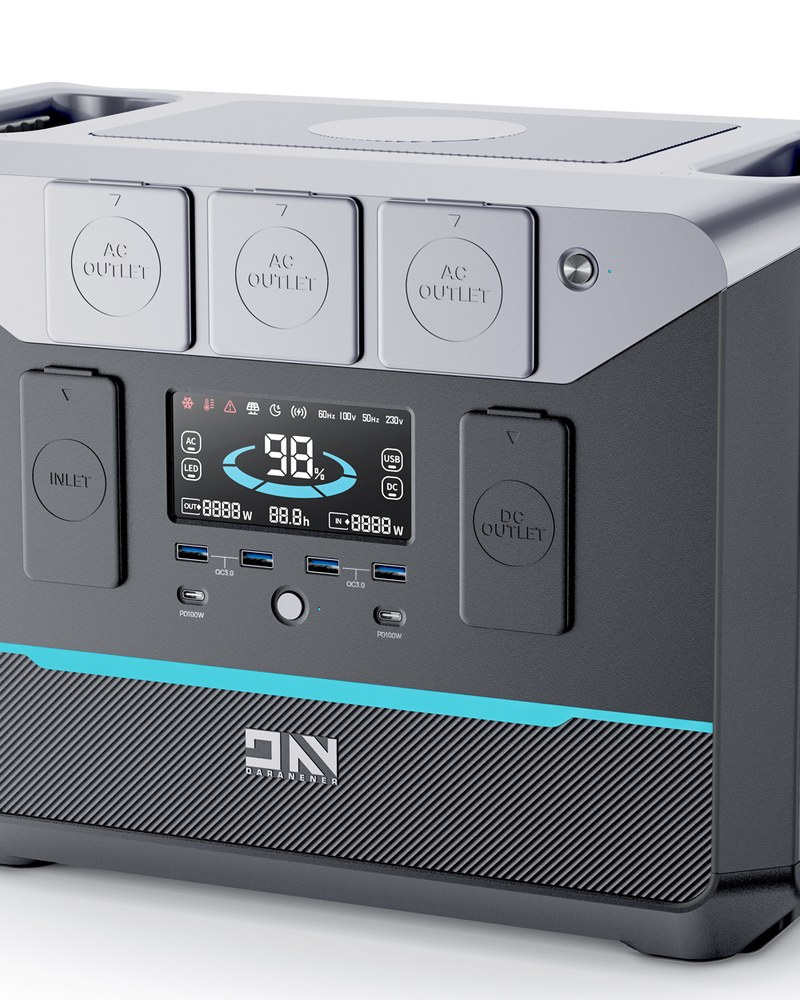
Interface detail: USB-C ports marked PD100W and PD60W, and the covered DC output — the enclosure is IP21, indoor use only.
OEM and private label: what changes
The NEO1800 Pro is manufactured by Shenzhen Daran New Energy (DN) and sold under the BEESTE brand; the factory's own mark appears on the housing of the shared enclosure tooling, which is why it shows in product photography.
That layer is more than a logo. Enclosure graphics and colour, packaging and carton artwork, manual language, outlet configuration for the destination market, and the ownership of certification all get agreed per project, because the last of those decides who can legally place the unit on a shelf in a given country. MOQ and tooling follow from which of those items actually change.
Buyers weighing this class against a 1000W unit should decide on the load list first and commercial terms second. The portable power station wholesale programme sets out how a project is scoped; the full NEO1800 Pro specification is the reference for a configuration discussion.
FAQ
Can the NEO1800 Pro run a refrigerator during a power outage?
Yes. A household fridge drawing about 150W on a duty-cycle average runs for roughly 7.8 hours, and its compressor start-up is covered by the 3600W three-second peak. Keep the door closed: every opening adds warm air and extends the compressor's run time, which is what actually shortens the figure.
How long will it run a CPAP machine overnight?
About 19.5 hours at 60W with the heated humidifier switched off, which covers two nights. With the humidifier on, draw more than doubles and the same pack gives a single night or less. Check your machine's voltage too: most run on 12V, some on 24V and need a step-up converter.
Is it a real UPS, or only a battery with an inverter?
It is a real UPS with a transfer time under 15ms, fast enough that routers, ONTs, NAS units and desktops ride through an outage without rebooting. It is not an online double-conversion UPS at 0ms, so equipment that specifies 0ms transfer — some precision medical and laboratory devices — needs separate assessment.
Can it run an air conditioner or an electric water heater?
No. Both are heating or compressor loads that exceed the 1800W continuous rating, and a water heater exceeds it by a wide margin. The three-second 3600W peak exists for motor start-up, not for sustained overload, so protection will trip rather than carry the load. For either appliance, this is the wrong product category.
How long does it take to recharge from the wall?
About 1.4 hours of bulk charging at the 1000W maximum, and about 1.5 hours to full once the current tapers at the end. The input accepts 200–240V, so the same charger works on UK and EU mains. A lower-wattage circuit will extend the time proportionally rather than damage the unit.
What solar array can it accept?
Panels between 11V and 80V, up to 10A, with an 800W ceiling on the XT60 input. An 800W array refills the pack in under two hours at good sun; a 400W array takes roughly twice as long. A single 12V-nominal panel often falls below the 11V floor, so two panels in series is the usual configuration.
Can all three AC outlets be used at once?
Yes, within a shared 1800W budget rather than 1800W each. Three 500W loads fit; two 1200W appliances do not. The USB and 12V outputs run from separate DC-DC converters, so they do not reduce the AC budget, though they do draw from the same battery and shorten total runtime.
Is it certified for sale in the UK and the EU?
The documents held are a UN38.3 transport test report and an MSDS. UL2743, FCC and PSE are design references, not certificates held, and no CE or UKCA declaration is asserted here. Certification is issued per model, so a report on one model does not mean the whole family is certified — ask for the report naming your exact SKU.
Can it be used outdoors or in the rain?
No. IP21 covers solid objects above 12.5mm and vertical dripping water only, which is an indoor rating. It should not be left on a balcony in weather, on a tent floor overnight, or anywhere it can be rained on. For outdoor work it belongs in a vehicle or under cover, with the side grilles kept clear.
How many charge cycles will the battery last?
At least 3000 cycles to 80% of original capacity at 80% depth of discharge. Two full cycles a week works out to nearly 29 years of cycling, which is a theoretical ceiling rather than a service life — calendar ageing applies regardless of use. The realistic planning figure is a ten-year design expectation, not a warranty term.
500W Portable Power Station for Camping and Road Trips: The 444Wh Reality Check
STAR 300Z: A 300W Portable Power Station Built for CPAP, Routers and 12V Fridges
Related Article