Portable Power Station Distributors: What to Ask Before You Sign
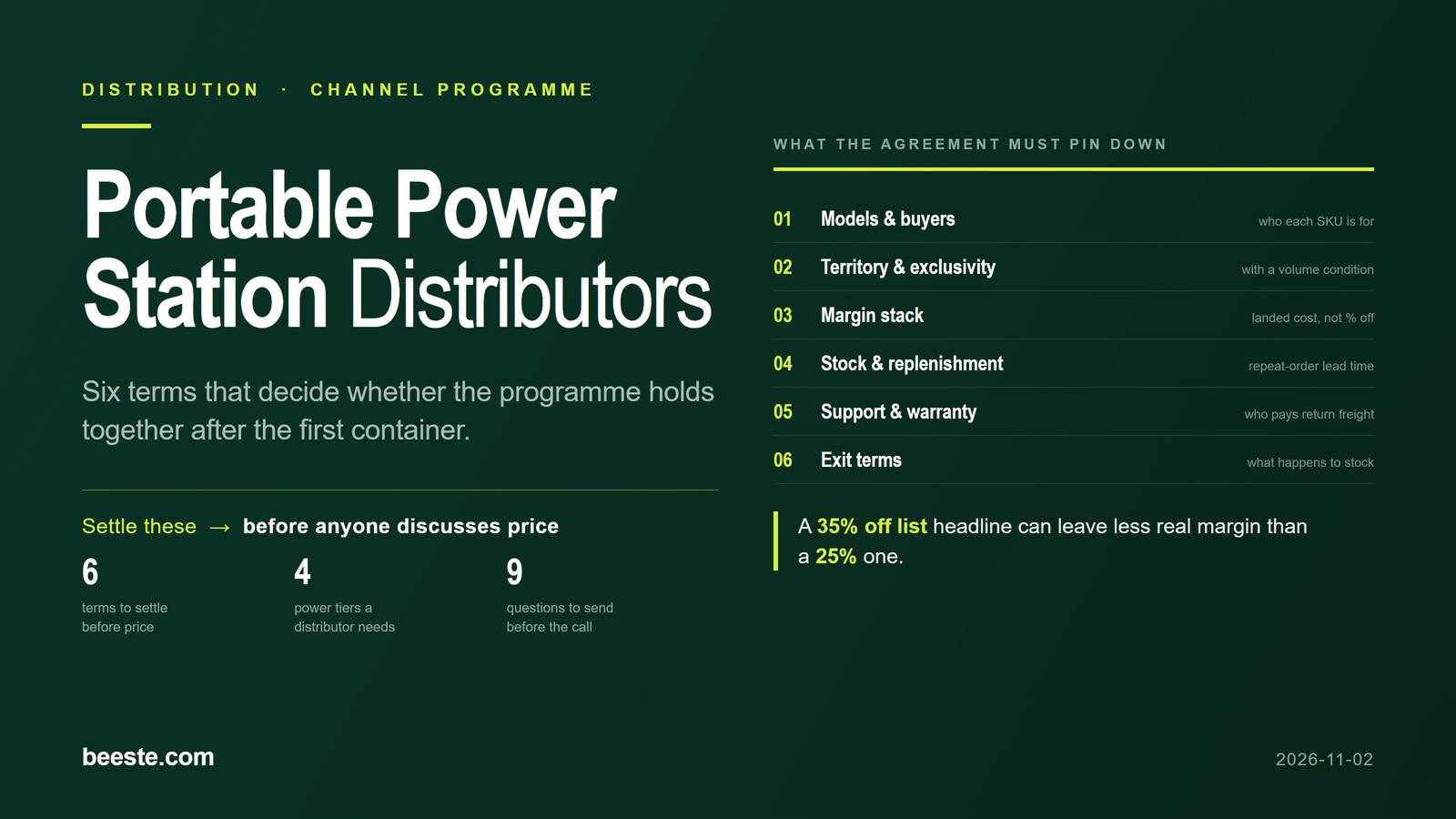
Most buyers searching for portable power station distributors are not looking for a reseller list. They are trying to work out whether a distributor programme will actually hold together after the first container — whether the territory means anything, whether the margin survives freight and duty, and whether the paperwork they inherit will stand up when a customer asks a hard question. The answer usually turns on six terms that are settled long before anyone discusses price. This guide walks through those six terms, the clause set that should appear in a distributor agreement, how to read a margin stack without flattering the numbers, and the red flags that show up again and again in this category.
It is written for buyers taking stock at container level — regional distributors, dealer networks, project resellers — not consumers buying a single unit.
What a distributor is actually buying
A distributor does not buy a product; it buys the right to sell a product into a defined market without being undercut, plus the supply reliability that makes a stock position safe to hold. Those are two different purchases, and most disappointing programmes fail on the second one rather than the first.
The category has a specific shape. Units are bulky relative to their value, so freight is a real share of landed cost. Batteries are regulated goods, so transport paperwork is not optional. And the range is wide — a 200W camping unit and a 2000W home-backup unit are not substitutes, so a distributor carries a spread rather than one hero SKU.
Why the category behaves differently from small electronics
Three properties drive everything else. First, weight and volume: a pallet of power stations costs materially more to move than a pallet of phone accessories of the same invoice value, which compresses the margin room available for distributor discounts. Second, lithium cells: shipping classification affects which carriers will take the goods and what paperwork travels with them. Third, seasonality: demand clusters around outage events and outdoor season, so a distributor who runs out in the middle of an event loses the sale permanently — the customer does not wait.
Why "we have many distributors" is not evidence
A factory with a large distributor roster may simply be selling to anyone who pays, which means your territory is unprotected. Ask instead how many distributors a region has, how long the longest relationship has run, and whether any distributor has been replaced. Factories that manage channels properly can answer all three immediately. Factories that do not will talk about total shipment volume instead.
Six questions that decide whether the programme works
These are the questions worth settling before price. Each has a concrete answer that can be checked, and each changes the economics materially.
Which models, and who actually buys them
A distributor needs to know the intended buyer for each model, not just the wattage. A 200W unit at 192Wh sells to campers and small-office backup buyers. A 2000W unit at 2073Wh sells to home-backup and light commercial users who are replacing a generator. Those two buyers behave completely differently: one buys on impulse at a retail shelf, the other asks for load calculations and warranty terms. If the factory cannot describe the buyer for each SKU, the distributor ends up guessing at stock mix — and stock mix is where distributor capital gets destroyed.
Territory and exclusivity
"Exclusive" is the most overused word in channel conversations. It should always be attached to three things: a defined geography, a defined channel (retail, project, e-commerce, or all three), and a performance condition. Exclusivity without a performance condition is a promise the factory can withdraw at will, and exclusivity without a defined channel is meaningless — a factory can grant you retail exclusivity and still sell project business into your region directly.
Ask what happens if you miss the target. The answer should be a defined step-down — exclusivity narrows to non-exclusive, or the territory shrinks — rather than termination. A factory that answers "we would discuss it" has not thought about channel management.
The margin stack
Distributor margin is not a single number. It is the difference between your sell price into your channel and your landed cost, and landed cost includes freight, duty, and inland movement. A "40% distributor discount" off an inflated list price can leave less real margin than a 25% discount off a realistic one. The next section shows how to test this properly.
Stock commitment and replenishment
Almost every distributor programme carries a minimum first order, and that is reasonable — factories need to schedule production. What matters is the replenishment term. Ask for the lead time on a repeat order of a model already in production, not the lead time on a new programme. The gap between those two numbers is often several weeks, and it is the number that determines whether you can restock inside a demand spike.
Support: marketing assets, spare parts, warranty handling
Three support items change your operating cost. Marketing assets: do you get product photography, spec sheets and copy you can use in your own market, or do you have to produce everything yourself? Spare parts: can you get replacement units or components for warranty cases, and at what price? Warranty handling: do you ship faulty units back to the factory, or does the factory accept a local scrapping credit? Return freight on a battery product is expensive enough that this term alone can wipe out a margin tier.
Exit terms
Ask what happens to your remaining stock if the relationship ends. A programme that requires you to destroy or return unsold inventory at your own cost is a programme that transfers all the risk to you. The reasonable position is that existing stock remains sellable for a defined period after termination.
The distributor agreement: clause by clause
The table below is the minimum clause set worth having in writing. It is not a substitute for legal review in your jurisdiction, but a factory that resists any of these items is telling you something useful.
| Clause | What it should say | What resistance looks like |
|---|---|---|
| Territory | Named countries or regions, with a map or list attached | "We will not sell there" with no definition of "there" |
| Channel | Which routes are yours: retail, project, online, or all | Silence on channel, or a verbal assurance only |
| Exclusivity | Conditional, with a stated annual volume and a step-down on miss | Verbal exclusivity, or exclusivity with no target |
| Price basis | Fixed for a stated period, with a defined adjustment mechanism | Price quoted "subject to raw material changes" with no formula |
| Minimum order | Units or value, per model or per order, stated clearly | A number that changes between conversations |
| Lead time | Repeat-order lead time, separate from first-order lead time | Only a first-order number offered |
| Warranty | Term, what is covered, and who pays return freight | Term stated but freight responsibility left vague |
| Spare parts | Availability period and pricing basis after end of production | No commitment, or "case by case" |
| Marketing assets | What the factory supplies and in what formats | Nothing in writing |
| Termination | Notice period, and what happens to held stock | Immediate termination at factory discretion |
How to read a margin stack without flattering it
The mistake is to compare discount percentages. The correct comparison is landed cost against achievable sell price in your own market, because that is the only number that becomes cash.
Landed cost per unit = FOB unit price + freight per unit + duty per unit + inland delivery per unit + inspection and handling per unit.
Gross margin % = (Sell price − Landed cost) ÷ Sell price × 100.
Worked example. A unit at 480 USD FOB, 40 units per pallet, sea freight 1,900 USD per pallet, duty at 3.5% of FOB, inland delivery 260 USD per pallet, inspection 150 USD per pallet:
- Freight per unit = 1,900 ÷ 40 = 47.50 USD
- Duty per unit = 480 × 3.5% = 16.80 USD
- Inland per unit = 260 ÷ 40 = 6.50 USD
- Inspection per unit = 150 ÷ 40 = 3.75 USD
- Landed cost = 480 + 47.50 + 16.80 + 6.50 + 3.75 = 554.55 USD
If your realistic sell price into your channel is 720 USD, gross margin is (720 − 554.55) ÷ 720 = 23.0%. A "35% off list" headline sounds better than 23%, which is exactly why the percentage-off framing is unreliable. Run the same arithmetic on the second-best quote before deciding anything.
| Line | Calculation | Example |
|---|---|---|
| FOB unit price | Quoted | 480.00 |
| Freight per unit | Pallet freight ÷ units per pallet | 47.50 |
| Duty per unit | FOB × duty rate | 16.80 |
| Inland per unit | Inland total ÷ units per pallet | 6.50 |
| Inspection per unit | Inspection total ÷ units per pallet | 3.75 |
| Landed cost | Sum of the above | 554.55 |
| Sell price | Your channel price | 720.00 |
| Gross margin | (Sell − Landed) ÷ Sell | 23.0% |
Two things fall out of this. First, freight per unit is driven by units per pallet, so packaging design is a margin lever — a factory that fits 44 units on the same pallet has just improved your margin without changing the FOB price. Second, duty is calculated on FOB, not on landed value, so a higher FOB with better freight efficiency can beat a lower FOB with poor packing.
Product line width: the four tiers a distributor actually needs
Distributor capital is finite, so the question is not "which models exist" but "which models earn their shelf space". In this category four tiers cover almost all demand, and each one has a distinct buyer and a distinct selling motion.
Tier 1 — 200W class, 192Wh
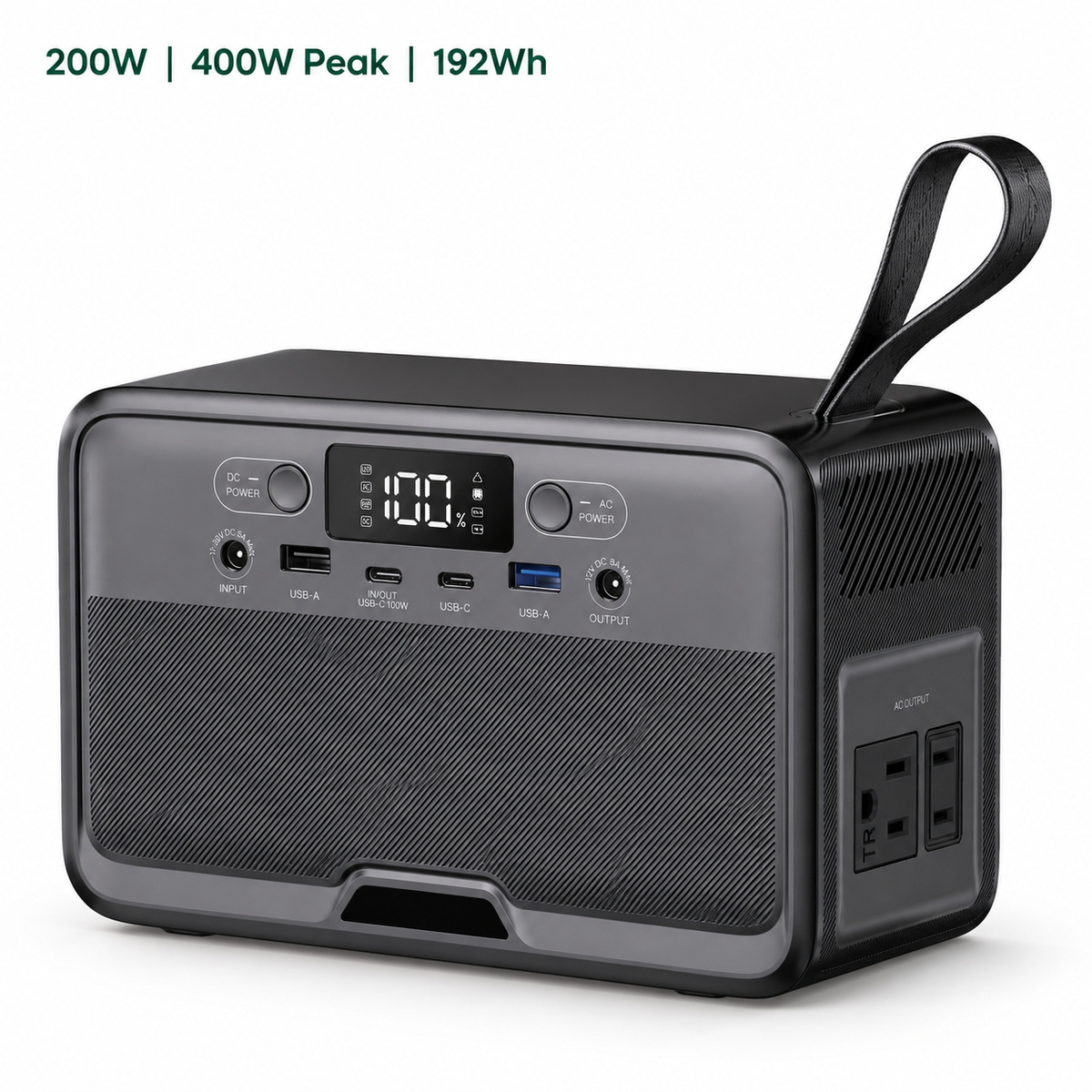
The 200W class at 192Wh is the entry SKU and the volume driver. It sells to campers, day-trip buyers and small-office backup users, and it is the model that gets a new brand onto a retail shelf. Carry it for traffic and for the account relationship, not for margin per unit — a retailer who stocks a 200W unit will listen to a conversation about the 1500W model.
Tier 2 — 600W class, 576Wh
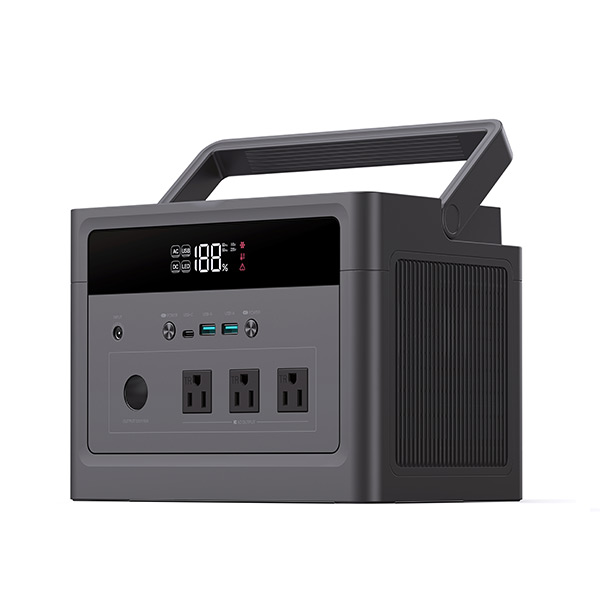
The 600W class at 576Wh is the balance point of the range. It is large enough to run a fridge through an outage and small enough to move without help. For a distributor this is usually the highest-turnover model after the entry SKU, and it is the model that most often justifies the stock position. If you can only hold three models, this is one of them.
Tier 3 — 1500W class, 1152Wh
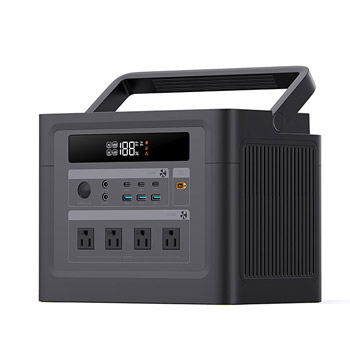
The 1500W class at 1152Wh is where the selling motion changes. The buyer is no longer browsing; they are solving a specific problem — a home office that must stay up, a job site without power, a small retail unit with a freezer. These buyers ask about surge capacity, runtime at a stated load, and warranty handling. A distributor who can answer those three questions closes this model at a higher ticket than the 600W class.
Tier 4 — 2000W class, 2073Wh
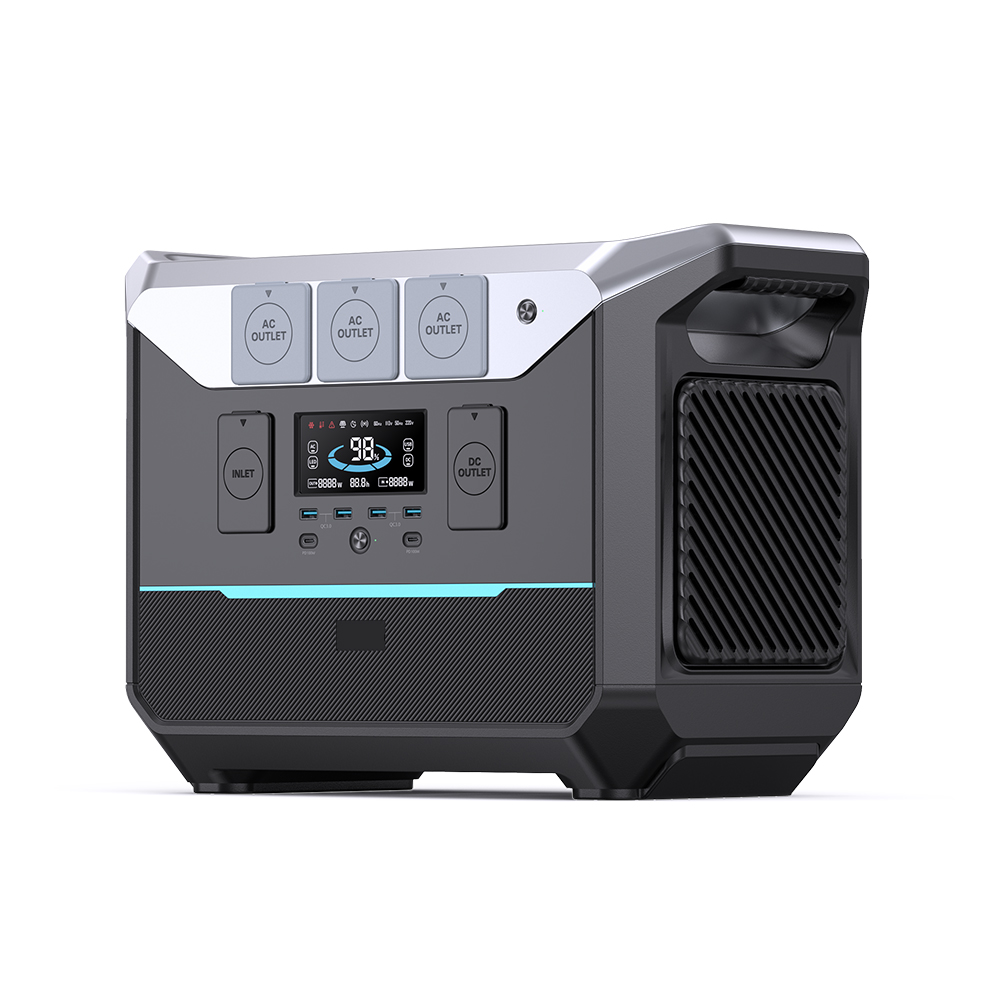
The 2000W class at 2073Wh is the project and light-commercial tier. It is the model that competes with small generators, and it sells into installers, event suppliers and commercial backup rather than retail shelves. Volume is lower but the ticket is higher, and the buyer expects technical support. Hold this tier only if you can support it — a distributor who sells a 2000W unit into a project without being able to answer load questions generates returns rather than repeat business.
| Tier | Capacity | Typical buyer | Selling motion | Role in the line |
|---|---|---|---|---|
| 200W | 192Wh | Campers, day-trip, small office backup | Retail shelf, impulse | Opens accounts, drives traffic |
| 600W | 576Wh | Households with occasional outages | Retail and online, considered | Highest turnover after entry |
| 1500W | 1152Wh | Home office, job site, small retail | Consultative, spec questions | Margin carrier |
| 2000W | 2073Wh | Installers, events, commercial backup | Project, technical support | Ticket builder, needs support |
For the full model list behind these tiers, the portable power station category page carries the current range with capacities and port configurations.
Stock, lead time and the cash question
Distributor failure in this category is usually a cash failure, not a sales failure. The arithmetic is simple enough to run before signing.
Sell-through weeks = Units held ÷ Average weekly sell-through.
Cash tied up = Units held × Landed cost per unit.
If you hold 120 units at 554.55 USD landed and sell 15 a week, you are carrying eight weeks of stock and roughly 66,500 USD of working capital. That is a defensible position if lead time on a repeat order is four weeks — you can reorder with a buffer. It is an unsafe position if repeat lead time is ten weeks, because any demand spike empties you and the refill arrives after the season.
The practical rule: repeat-order lead time plus two weeks should be shorter than your sell-through weeks. If it is not, either reduce the stock position or negotiate a faster replenishment term before you sign.
| Scenario | Stock held | Weekly sell-through | Weeks of cover | Repeat lead time | Position |
|---|---|---|---|---|---|
| Lean | 60 units | 15 | 4.0 | 4 weeks | Too tight, no buffer |
| Balanced | 120 units | 15 | 8.0 | 4 weeks | Workable |
| Heavy | 200 units | 15 | 13.3 | 4 weeks | Cash-heavy, watch ageing |
| Fragile | 120 units | 15 | 8.0 | 10 weeks | Exposed to any spike |
Compliance documents you inherit as a distributor
When you resell, the documentation obligation moves to you. Four document sets are worth holding before the first shipment arrives, and asking for them early is a useful test of how organised the factory is.
Transport and battery documents
Lithium cells travel under transport rules that require a test summary and, depending on mode and packaging, specific marking. Ask for the current documents that accompany the shipment, not a generic certificate PDF from an earlier year. If the factory cannot produce them quickly, the delay will land on your freight forwarder.
Market access documents for your territory
Requirements differ by market, and the marking on the product must match the documentation you can produce. Ask for the test reports behind the marking rather than a picture of the label, and confirm the reports name the model you are ordering — not a sibling model in the same family.
Label and language requirements
Retail packaging in most markets carries mandatory language, importer identity and warning text. Confirm who produces the artwork and who is responsible for the accuracy of translated warnings. This is a common source of customs holds, and it is cheap to settle in writing before production.
Traceability
Ask whether units carry a serial or batch code that maps to a production record, and whether the factory can trace a specific unit back to its cell batch. This matters when a customer reports a fault and you need to know whether it is isolated or systematic.
Red flags that repeat in this category
None is fatal alone. Together they describe a supplier selling product rather than building a channel.
- Price quoted before specifications. If the first reply is a price list without asking which market, which channel, or which volumes, the factory is quoting a catalogue rather than a programme.
- Exclusivity offered immediately. A factory that grants exclusivity in the first email has either not understood the request or does not intend to honour it.
- Lead time quoted as a single number. First order and repeat order are different processes; one number means one of them is a guess.
- Warranty freight left unstated. On a battery product, who pays return freight is a larger number than most distributors expect.
- Model list without buyer descriptions. If the factory cannot say who buys each SKU, they cannot help you build a stock mix.
- Documents promised "after deposit". Test summaries and market access reports exist before the order or they do not exist.
- No named contact for after-sales. A programme with only a sales contact has no path for the first warranty case.
Questions to send before the first call
Sending these in writing filters conversations quickly. A factory that answers them in detail is worth a call; one that replies with a price list has told you what kind of supplier it is.
- Which models do you recommend for my market, and who is the intended buyer for each?
- How many distributors do you currently have in my region, and in which channels?
- What annual volume would justify exclusivity, and what happens if I miss it?
- What is the repeat-order lead time for a model already in production?
- What is the minimum first order, and is it per model or per shipment?
- Who pays return freight on a warranty claim, and what is the accepted process?
- What marketing assets do you supply, and in which formats?
- Can you send the transport and market access documents for the model I am considering?
- What happens to my remaining stock if the agreement ends?
Frequently asked questions
What margin should a portable power station distributor expect?
It depends on the tier and the market, and any single number quoted without context is unreliable. Work from landed cost instead: after freight, duty, inland delivery and inspection, a distributor buying at container level typically needs enough headroom to cover channel margin, warranty exposure and slow-moving stock. Run the landed-cost calculation on your own freight quotes before comparing supplier discounts, because the same headline discount produces very different real margins depending on units per pallet.
Is exclusivity worth paying for with a higher minimum order?
Only if the territory is defined and the volume target is one you can realistically hit. Exclusivity priced as a higher minimum order transfers risk to you without guaranteeing anything in return, unless the agreement also states what the factory will not do — no direct sales into your region, no second distributor in the same channel. A conditional exclusivity with a clear step-down is worth more than an unconditional one with no mechanism.
How many models should a new distributor start with?
Three is usually the practical minimum: an entry model to open retail accounts, a mid-range model that carries turnover, and one higher tier to capture bigger tickets. Starting with the full range spreads working capital across slow movers. The four tiers described above exist so you can choose which three fit your market rather than carrying everything.
What documents should arrive with the first shipment?
Transport documentation for the battery, the test reports behind the market access marking for your territory, and a packing list that maps serial or batch codes to the shipment. Ask for these before production, not after, because missing paperwork at the port is resolved on your side of the transaction.
How do I tell a manufacturer from a trading company?
Ask three questions that a trading company cannot answer cheaply: which production steps happen inside your own facility, can you send a video walk-through of the line producing my model, and can you trace a unit's serial number back to its cell batch. A manufacturer answers all three with specifics. A trading company answers with generalities or redirects to a catalogue. The 2000W portable power station and 1500W portable power station pages show how a factory-built unit is documented, and the 600W portable power station page covers the mid-range model most distributors stock first.
Next step
If you are evaluating a distributor programme for this category, send the nine questions above before you discuss price. The answers will tell you more about the supplier than any catalogue will, and they will show you where the real margin sits once freight and duty are in the arithmetic.
For territory availability, minimum order levels and repeat-order lead times in your market, contact us with your region and the tiers you intend to carry, and we will reply with the model list that fits rather than the full catalogue.
Solar Generator Manufacturers in China: Factory Types and What They Supply