Top Portable Power Station Manufacturers: What the Ranking Measures
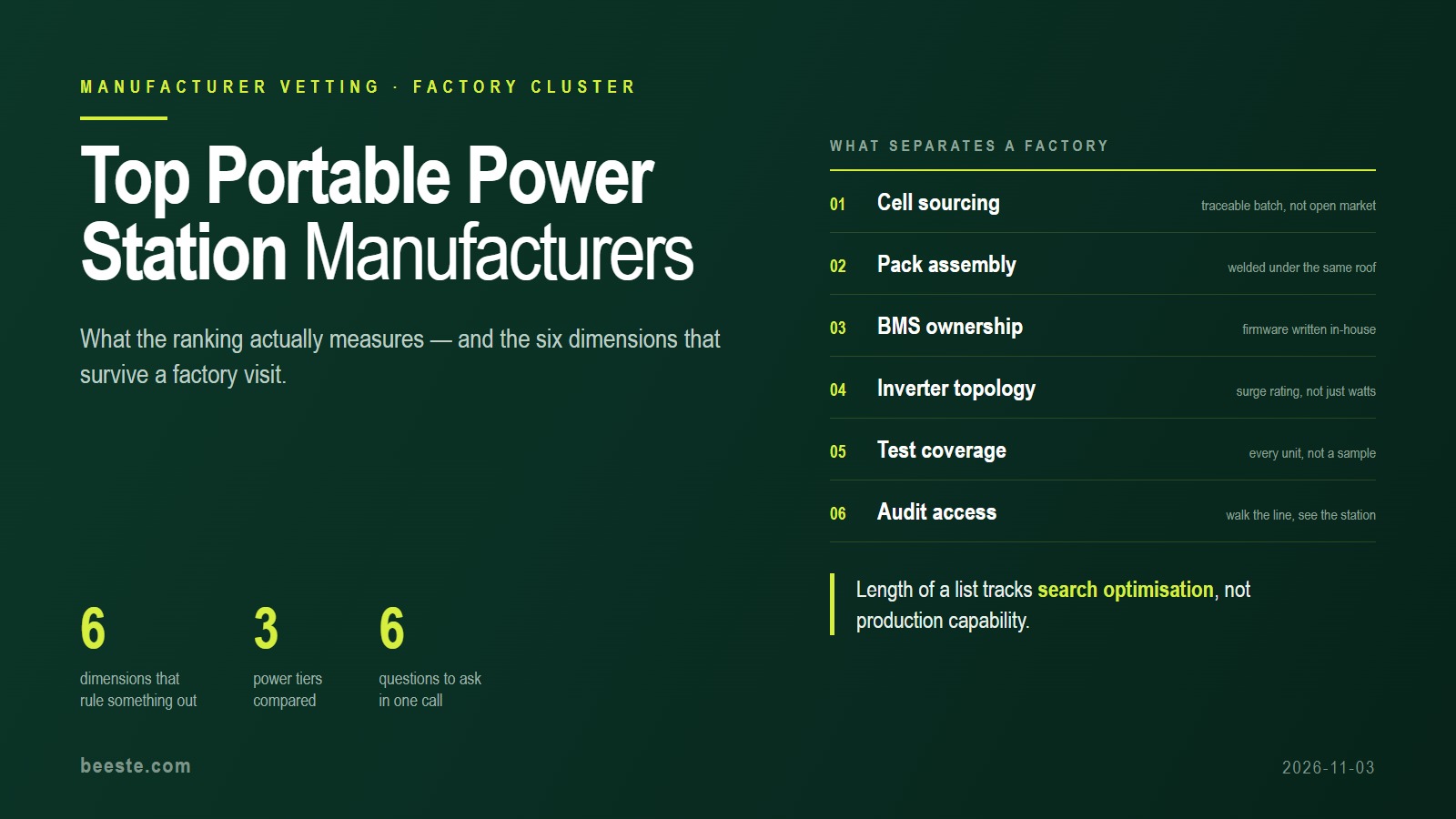
Most lists of top portable power station manufacturers are assembled from press releases, affiliate pages and self-reported capacity figures, which is why two lists published in the same month can share almost no names. A ranking like that measures marketing reach, not manufacturing capability. What actually separates a supplier is narrower and harder to fake: cell sourcing, in-house pack assembly, BMS firmware control, inverter topology, test coverage, and whether the supplier will let a buyer audit those four. This page sets out the six dimensions that survive a factory visit, then applies them to the three tiers OEM buyers order most.
Why a "top 10" list usually measures the wrong thing
A published ranking is only as good as its input. When the input is a company's own brochure, the ranking reproduces marketing spend. Three failure modes recur:
Ranking by capacity. Watt-hours are the easiest number to print and the easiest to inflate. A pack rated 1,000Wh that delivers 880Wh under a 500W load has not lied about the cell, but it has described a system it does not quite build. Capacity is a starting spec, not a discriminator.
Ranking by catalogue size. A supplier listing forty SKUs may be a factory with a wide tooling set, or a trading company with forty supplier PDFs. Catalogue breadth speaks to merchandising, not to who owns the moulds.
Ranking by logos. A mark on a web page is a claim about a document, not a document. The document carries a holder name, a model list and an expiry date; those three fields are what a buyer should read. A supplier who will not send it has told you something useful.
The six dimensions that actually separate manufacturers
Each dimension rules something out, and the right-hand column matters more than the left: it is where a marketing claim stops being checkable.
| Dimension | What it tells you | What it rules out |
|---|---|---|
| Cell sourcing | Whether cells come from a tier-one supplier under a traceable batch, or from the open market | Rules out a pack builder who cannot name a cell vendor or show an incoming inspection record |
| Pack assembly | Whether welding, stacking and busbar work happen under the same roof as final assembly | Rules out a trading company that outsources the pack and only boxes the unit |
| BMS ownership | Whether protection thresholds and balancing logic are written in-house or bought as a sealed module | Rules out firmware customisation, because the parameters are not theirs to change |
| Inverter topology | Whether the sine wave stage is designed in-house, with a stated surge rating | Rules out suppliers who quote a wattage with no surge figure |
| Test coverage | Whether every unit sees ageing and load testing, or only a sample does | Rules out "tested to standard" claims with no unit-level record |
| Audit access | Whether a buyer's engineer can walk the line and see the test station | Rules out every claim that exists only in a deck |
The order is deliberate: the first two decide whether the supplier is a manufacturer at all, the middle two whether they can customise, the last two whether you can trust the first four answers.
What the dimensions look like across three power tiers
The same six questions apply at every size, but the answers change. A 600W unit is a weekend product with a small pack; a 2000W unit is a backup product where surge behaviour and thermal design dominate. The specifications below are taken from product pages rather than a brochure.
| Specification | 600W class | 1000W class | 2000W class |
|---|---|---|---|
| Rated AC output | 600W (surge 1200W) | 1000W (surge 2000W) | 2000W (surge 3000W) |
| Energy capacity | 576Wh | 960Wh | 2073.6Wh |
| Cycle life | >3000 to 80% | >3000 to 80% | >3000 to 80% |
| Dimensions (L×W×H) | 28.2×19.9×19.1cm | 32.2×21.3×24.4cm | 47.6×26.4×34.5cm |
| Net weight | 6.9kg | 10.5kg | 25.7kg |
| AC outlets | 100–240V, 50/60Hz | 100–240V, 50/60Hz | 3× 100–240V, 50/60Hz |
| USB-C | 1× 100W | 2× (100W + 18W) | 2× 100W |
| 12V output | Car socket 120W | XT60 120W | 4× DC 120W, car 120W |
Read the weight row and the surge row together. Divide capacity by weight and all three land in a similar band — expected for a LiFePO4 pack in a steel enclosure, and a useful cross-check when a supplier quotes generous numbers. A figure far outside that band usually means one of the two is wrong; ask which.
Surge headroom describes the inverter, not the battery. Two tiers run at roughly 2× rated and the 2000W unit at 1.5×: a bigger continuous stage costs more heatsink and volume, so the multiple narrows as the rating rises. Claim a high continuous rating and a 3× surge in one enclosure and expect a request for the thermal test.
How to run the check in one supplier call
Six questions get you most of the way, and none require a factory visit to ask.
Which cell vendor and batch does the current production run use, and can you see the incoming inspection record? Is the pack welded in-house, and how many welds per tab? Who wrote the BMS firmware, and what is the low-temperature charge cutoff? What is the surge duration in seconds, not just the peak wattage? What percentage of units see a full-load ageing test versus a sample? Can a buyer's engineer visit the test station?
A supplier answering four of six with a specific number is worth a second call; one answering all six with adjectives is not, wherever they rank. If the answers hold, the next step is a specification match against a real range — the portable power station manufacturer line covers the three tiers above, and a quote request should name the tier rather than the brand.
Frequently asked questions
Is a longer manufacturer list more reliable?
No. Length correlates with search optimisation effort, not production capability. A list of forty names often contains three or four actual factories and a long tail of resellers.
Does cycle life settle the argument?
Only if the test conditions are stated. A figure of 3,000 cycles to 80% means little without depth of discharge, C-rate and temperature. Ask for all three; a supplier who can supply them is usually the one whose number holds.
Should capacity or surge rating drive the choice?
Surge, for any load with a motor. A compressor or pump can draw two to three times its running wattage at start, so a unit sized on running watts alone will trip. Size on surge first, then check capacity against the runtime you need.
Can a trading company still be the right supplier?
Sometimes, if the factory behind it is stable and the trader adds real services — consolidation, documentation, after-sales. The test is whether they will name the factory and let you audit it. A trader who hides the source is a single point of failure.
For a tier-by-tier comparison, the 600W portable power station, the 1000W portable power station and the 2000W portable power station pages carry the full published specifications. To put the six questions to us directly, use the contact page for the energy storage manufacturer — a technical reply is more useful than a catalogue.
Portable Power Station Distributors: What to Ask Before You Sign
Related Article