How to Import Portable Power Stations into the US: Certifications, Tests and Documents
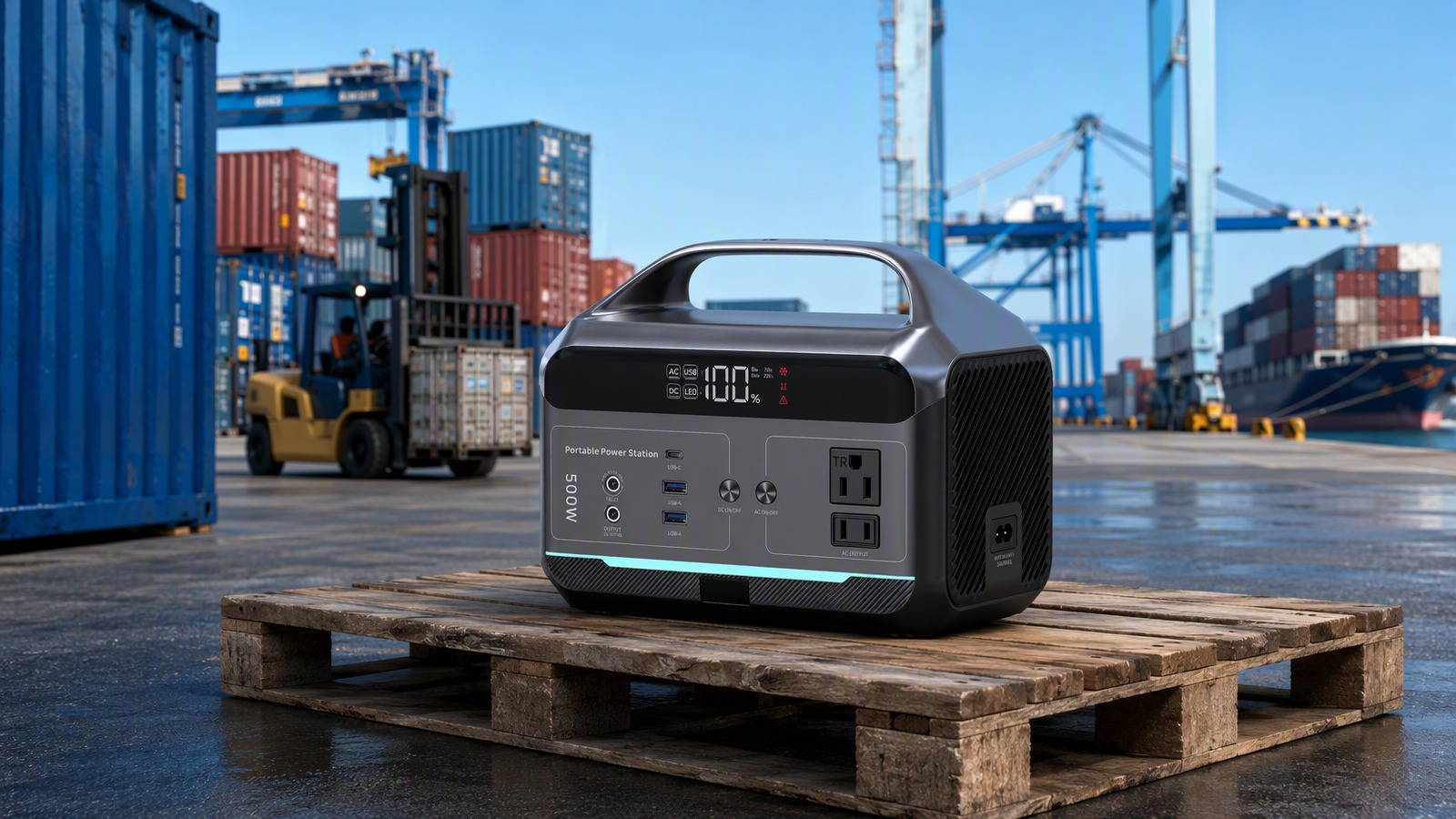
How to Import Portable Power Stations into the US: Certifications, Tests and Documents
There is no single "US import certificate" for a portable power station. Four things decide whether your shipment clears and whether US retailers will list it: UN 38.3 for transport, FCC Part 15 authorisation for the electronics, UL 2743 as the safety standard the market expects, and correct country-of-origin and Proposition 65 labelling. Get those four right and everything else is documentation hygiene.
Why a portable power station needs UL 2743, not UL 2056
UL 2743, the Standard for Portable Power Packs, was first published on 14 October 2016. It covers devices that consist of one or more batteries in an enclosure and are intended to be used as a portable power source when normal grid power is unavailable — including units with a booster or jump-start function.
The distinction that catches new importers is scope. UL 2743 does not cover phone-charging battery packs; those fall under UL 2056, the Outline of Investigation for Safety of Power Banks. UL 2056 states the exclusion in the other direction too: it does not cover products within the scope of UL 2743.
So a unit with a 110 V AC outlet — a 288 Wh, 500 W station, for example — is a portable power pack. A slim 10,000 mAh phone charger is a power bank. They are different standards, and a UL 2056 report will not satisfy a buyer who asked for UL 2743.
US safety standards are voluntary on paper — and not optional in practice
Unlike the EU's CE marking regime, the United States has no mandatory federal test report for this product category. That does not make compliance optional. Liability for injury or fire damage applies whether or not a mandatory standard exists, and the CPSC publishes a list of standards relevant to batteries: ANSI/NEMA C18, UL 1642 for lithium cells, UL 2054 for household and commercial batteries, UL 2056 and UL 2595.
The practical pressure comes from the channel. Marketplaces and large retailers ask for a valid UL 2743 test report before they will list a portable power station, and they can request the report at any time after listing. Treat the test report as a market-access document, not a legal formality.
UN 38.3 is the requirement that is genuinely mandatory
UN 38.3 sets requirements for transporting lithium batteries and applies to every cell and battery manufactured after 30 June 2003. It governs both the shipment from your factory and domestic distribution once the goods are in the country. Without it, the goods cannot legally move.
What you should hold is not a verbal assurance but the UN 38.3 test summary for the exact cell and pack configuration you are buying. Air shipments carry additional requirements — IATA packing instructions and state-of-charge limits — and the outer packaging needs the correct Class 9 lithium battery mark and label.
FCC Part 15 depends on whether your unit is an intentional radiator
47 CFR Part 15 applies to the electronics inside the station, and the authorisation route depends on the configuration:
- No Wi-Fi or Bluetooth — the unit is an unintentional radiator. You use the Supplier's Declaration of Conformity (SDoC) procedure: test against the relevant standard (for example ANSI C63.4-2014), produce a compliance information statement, and label the product with its identification and the compliance statement.
- Bluetooth or Wi-Fi app control — the unit becomes an intentional radiator and must be authorised through the Certification procedure: testing by an FCC-recognised accredited lab, a technical report, an FCC ID, and approval through a Telecommunication Certification Body.
This matters commercially: the same hardware sold with and without an app is two different compliance paths, and the version with the app costs more and takes longer.
The document pack to request from your factory
| Document | What it proves | Issued by |
|---|---|---|
| UN 38.3 test summary | Transport compliance for the cell and pack as configured | Accredited battery test lab |
| UL 2743 test report | Product safety for portable power packs | NRTL such as UL, Intertek or TÜV |
| FCC SDoC or FCC ID grant | Radio frequency compliance for the electronics | Manufacturer (SDoC) or TCB (certification) |
| Cell-level report (UL 1642 / IEC 62133-2) | Safety of the cells themselves | Cell manufacturer or test lab |
| Material safety data sheet | Hazard communication for handlers and carriers | Manufacturer |
| Country-of-origin declaration and label artwork | Mandatory origin marking | Manufacturer |
| Proposition 65 statement | Chemical content for the California market | Manufacturer, supported by material declarations |
Three traps that cost importers the most
- Cell substitution after testing. A test report is valid only for the configuration that was tested. Swap the cell model or brand and the report no longer applies to the goods you receive. Lock the bill of materials in writing and audit it against the report.
- Unattributed "UL certified" claims. The claim is only meaningful with the standard number and the file reference attached. A logo without a standard number tells a buyer nothing.
- Assuming UL 20**56** covers the product. It does not, for any unit with an AC outlet. This is the single most common mismatch between what a factory provides and what a US buyer requires.
What to ask before you place a purchase order
- Is the unit classified under UL 2743, and is the test report issued for the exact configuration we are purchasing?
- Can you send the UN 38.3 test summary for the specific cell and pack?
- Does the model ship with an app or Bluetooth — and if so, is there an FCC ID?
- Which cell brand and model is in the bill of materials, and is it the one in the report?
- Who produces the country-of-origin label, and where is it applied?
- What is the stated Proposition 65 position for the enclosure materials?
How BEESTE documents this
BEESTE's NEO 501 portable power station (500 W, 288 Wh LiFePO4) is documented against FCC, UN38.3, UL2743, PSE, SP188, MSDS, METI, UL, CE and RoHS, with test standards EN55022, GB 4943.1-2011, IEC60950-1, IEC62133 and UL1642 recorded in the product specification sheet. For OEM/ODM projects we can supply the report set for the specific configuration you intend to import and, where a change of cell or component is required, scope the retesting with you before tooling is committed.
Sourcing question?
Tell us which channel you work in and we will route your inquiry to the right team:
- OEM/ODM & Customization — private label, custom colour, packaging and configuration
- Distribution & Wholesale — regional distribution, volume pricing, product line planning
- Projects & Installation — job site, event and off-grid deployments
Power Smarter, Live Free.
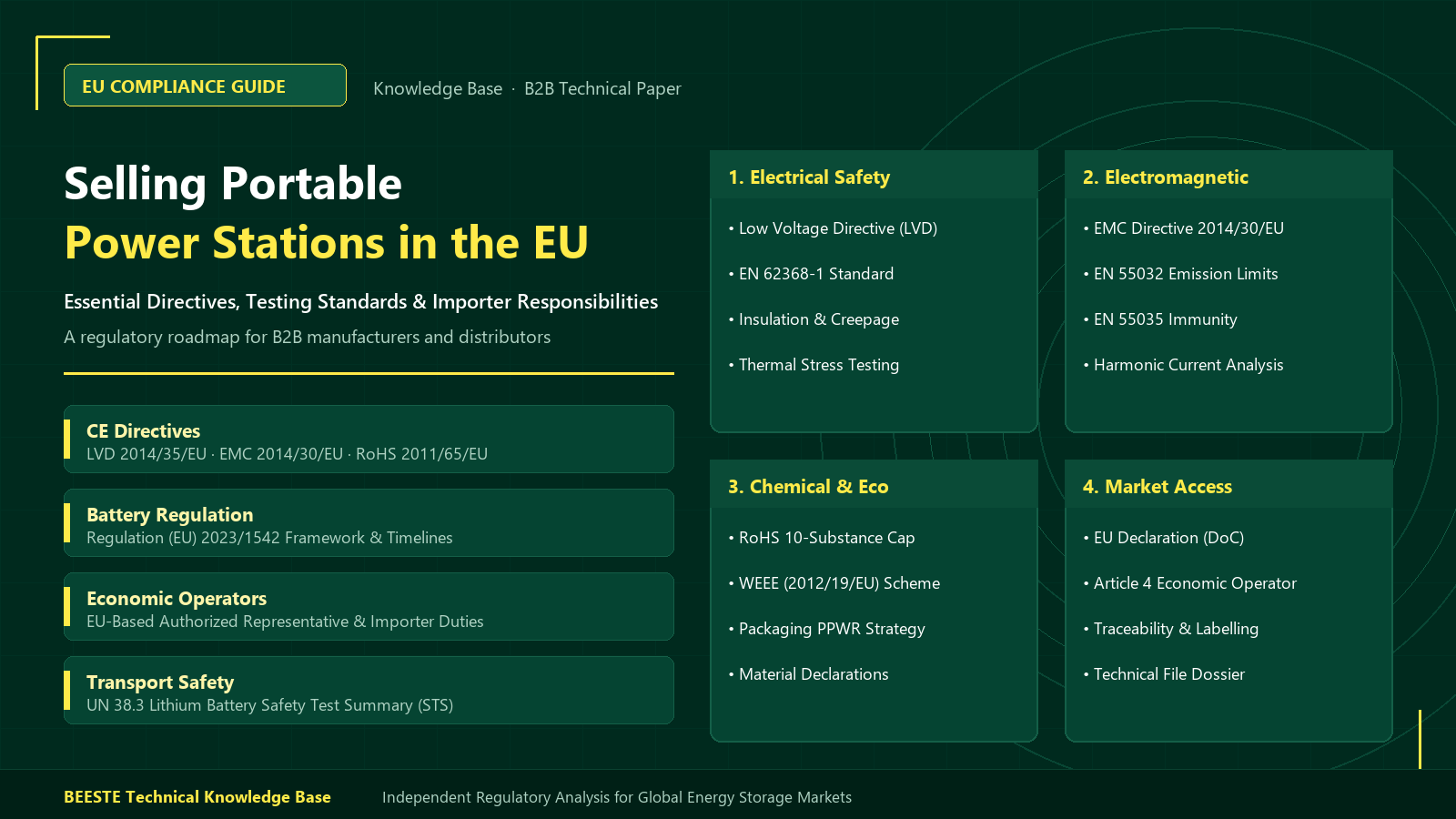
What Certifications Are Required to Sell Portable Power Stations in the EU
Related Article