What Certifications Are Required to Sell Portable Power Stations in the EU
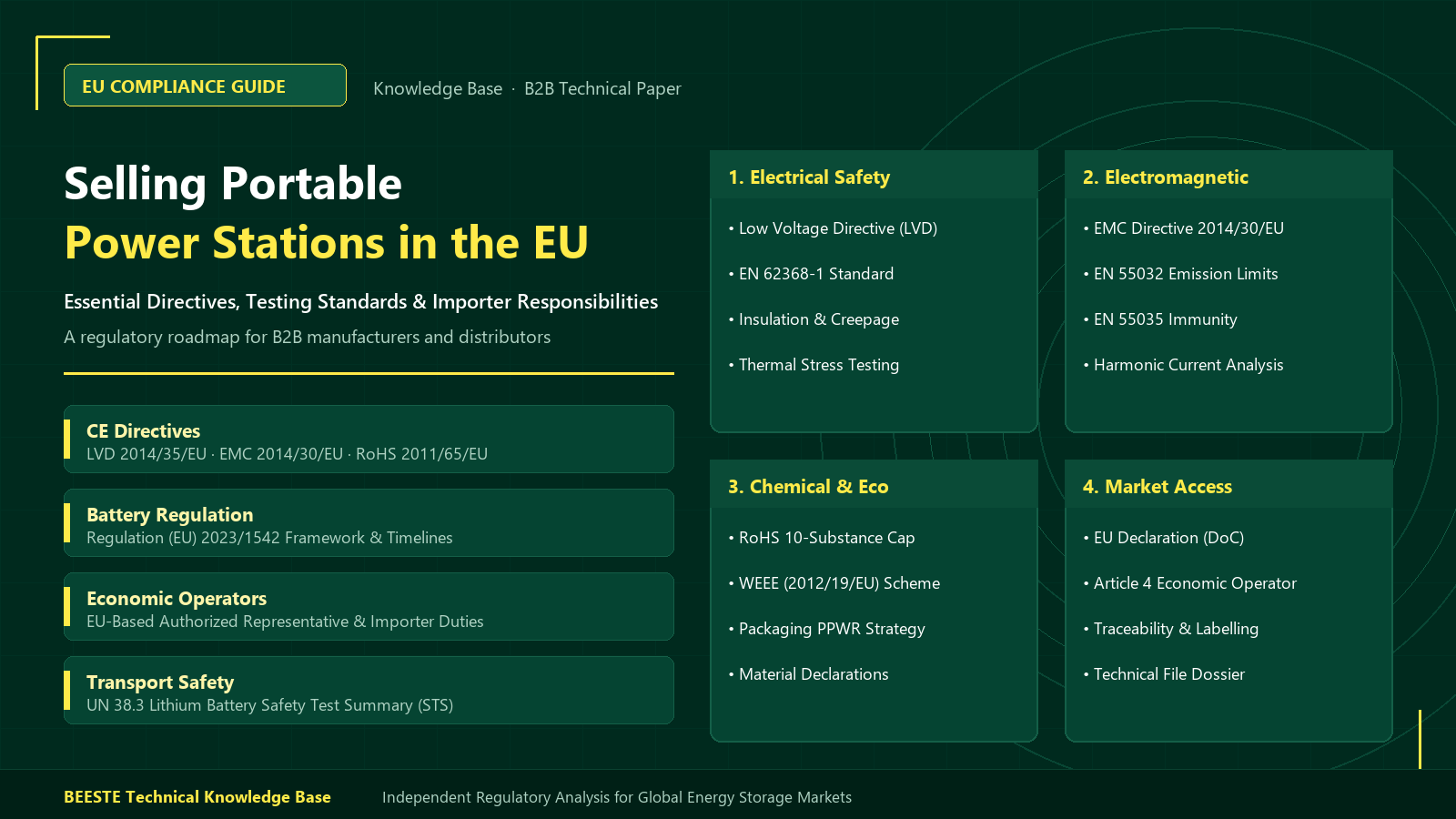
There is no single EU certificate for a portable power station. Four obligations decide whether one can legally be placed on the EU market: CE marking under the Low Voltage, EMC and RoHS Directives; an economic operator established in the EU; battery duties under Regulation (EU) 2023/1542; and UN 38.3 for shipping. The second is where most non-EU sellers come unstuck.
CE marking is three directives, not one certificate
A station with AC outlets for a 230 V market falls inside the Low Voltage Directive 2014/35/EU, which covers equipment rated 50 V to 1,000 V AC. Its inverter and charger electronics fall under the EMC Directive 2014/30/EU. Restricted substances come under RoHS 2011/65/EU. Bluetooth or Wi-Fi adds the Radio Equipment Directive 2014/53/EU.
CE is a manufacturer's declaration. No EU agency issues a CE certificate, and there is no EU-wide type approval for this category. The routine is to test against the relevant harmonised standards, compile technical documentation, and issue an EU Declaration of Conformity naming the directives and standards applied. Such declarations for this equipment family commonly cite the EN 62368-1 safety family and the EN 55032 / EN 55035 EMC family.
The requirement most sellers miss: an EU economic operator
Article 4 of Regulation (EU) 2019/1020 allows a product to be placed on the EU market only if an economic operator established in the Union is responsible for it. The Low Voltage, EMC, RoHS and Radio Equipment Directives and the Batteries Regulation are all covered, so a portable power station needs a responsible person inside the EU.
Four roles qualify: manufacturer, importer, authorised representative, or fulfilment service provider. A distributor cannot. So a factory's Declaration of Conformity is not sufficient on its own, and the operator's name and contact details must appear on the product, packaging or accompanying documents. Direct-to-consumer sellers should appoint an authorised representative or fulfilment provider before packaging artwork is finalised.
Battery duties depend on battery weight
Regulation (EU) 2023/1542 replaced Directive 2006/66/EC and has applied since 18 February 2024. It sorts batteries into five categories, and one line can straddle two:
- Portable battery — sealed, 5 kg or less, not classified as another type.
- Industrial battery — designed for industrial use, intended for industrial use after repurposing, or any other battery above 5 kg that is not an EV, LMT or SLI battery.
A 288 Wh unit whose pack is under 5 kg is a portable battery; a 1.5 kWh pack above 5 kg is an industrial battery — same line, different duties. CE marking also applies to the battery itself, which needs its own EU Declaration of Conformity.
Key dates, including those already in force
| Milestone | Date |
|---|---|
| Regulation applies; replaces Directive 2006/66/EC | 18 February 2024 |
| Safety, performance and durability duties; economic operator obligations | 18 August 2024 |
| Supply chain due diligence; waste battery management | 18 August 2025 |
| Carbon footprint for rechargeable industrial batteries | 18 February 2026 |
| Battery passport above 2 kWh; removability of portable batteries | 18 February 2027 |
| Recycled content for industrial, EV and SLI batteries | 18 August 2028 |
Removability is a design rule
Portable batteries must be removable and replaceable by the end-user using commercially available tools. Proprietary tools count only if supplied free with the product, and heat or solvents are not permitted. This starts on 18 February 2027 — close enough for next year's design brief.
UN 38.3 covers shipping, not market access
UN 38.3 is the transport requirement, referenced by ADR for road, the IMDG Code for sea and the ICAO / IATA rules for air. Buyers want the test summary covering the exact cell and pack configuration, plus the MSDS. CE does not cover transport.
What to ask your supplier for
| Requirement | Evidence to hold |
|---|---|
| Product CE: LVD, EMC, RoHS | EU Declaration of Conformity; test reports; technical file |
| Radio, if app or Bluetooth controlled (RED) | Declaration of Conformity; radio test report |
| EU responsible person (2019/1020, Article 4) | Written mandate; operator name on product or packaging |
| Battery CE and labelling (2023/1542) | Battery Declaration of Conformity; label and QR information |
| Producer registration (EPR) | Registration number in each member state of sale |
| Transport | UN 38.3 test summary; MSDS for the shipped configuration |
One caution: test reports are valid for the tested configuration only — a cell or BMS change invalidates them.
Frequently asked questions
Does the EU issue a CE certificate for a portable power station?
No. CE is a manufacturer's declaration based on testing and technical documentation. No EU authority issues a single certificate, and market surveillance authorities check the Declaration of Conformity and the technical file instead.
My factory already has CE documents. Is that enough?
It covers the technical half only. Regulation (EU) 2019/1020 still requires an EU-established economic operator to be responsible for the product, and that is the requirement most buyers discover only when a distributor asks for it.
Does a portable power station need a battery passport now?
Not for most portable models. Passports start on 18 February 2027 for rechargeable industrial batteries above 2 kWh and for EV batteries. Whether your own pack counts as portable or industrial turns on the 5 kg line.
Ask us for the EU document pack
Tell us the model and the member states you are targeting, and we will assemble the applicable documents for that configuration: Declaration of Conformity drafts, test reports, battery category position, and the labelling and operator-detail requirements that affect your artwork.
WEEE Registration for Portable Power Stations: Who Registers
How to Import Portable Power Stations into the US: Certifications, Tests and Documents
Related Article