How Many Watts to Run a Refrigerator, and What Size Station Covers It

The question usually arrives the day before a power cut, or while specifying a container for a dealer. How many watts to run a refrigerator is not one number, because a refrigerator has two: the watts it draws while the compressor runs, and the far larger draw for the second or two when the compressor starts. Size the station against the second number, then check the first against its continuous rating. That is the whole method.
Why a refrigerator has two wattage numbers
A refrigerator is a compressor, a fan and a thermostat in a box. The fan and control board draw a few watts and never change. The compressor is a motor, and a motor at standstill looks almost like a short circuit until it spins up. That instant — locked rotor — is when current peaks. Within a fraction of a second the motor reaches speed and the refrigerator settles into its running draw for the next twenty or thirty minutes.
Two consequences follow:
- Running draw decides runtime. Capacity in watt-hours divided by running watts gives hours.
- Starting draw decides whether the compressor switches on at all. If the inverter trips on inrush, the refrigerator never starts, and no amount of extra battery capacity fixes it.
Most sizing mistakes ignore the second number. A station that could run a refrigerator for eighteen hours is useless if its inverter folds at the moment of start.
Getting your own number in ten minutes
Three methods, in order of accuracy:
1. Read the nameplate, then multiply. The rating label sits inside the fresh-food compartment or on the back. It gives volts and amps, sometimes locked rotor amps (LRA). Running watts is roughly volts × running amps. If the label only gives LRA, that is your starting figure — do not use it for runtime maths.
2. Measure it. A plug-in energy monitor between socket and refrigerator gives running watts directly and records peak watts over a few days. This is the only method that captures your actual duty cycle, which moves with room temperature, door openings and how full the box is.
3. Work back from the energy label. Annual kWh ÷ 8,760 gives average draw. Average is not running draw — the compressor cycles — but their ratio converts capacity into wall-clock cooling hours.
Do not estimate from cubic feet alone: two refrigerators of the same size can differ twofold in running watts, depending on compressor, insulation and age.
The sizing rule that actually holds
Three conditions, all of which must be true:
- Continuous: rated AC output must exceed running watts, with headroom for the fan, light and control board.
- Surge: the station must sustain the compressor's starting draw for the duration its spec sheet states. Short-term figures are always time-limited — 200 milliseconds is a different claim from 30 seconds, and compressor starts fall between them.
- Energy: capacity × 0.85 ÷ running watts gives continuous hours. The 0.85 is a derate for inverter losses and depth-of-discharge limits, not a marketing figure.
Oversizing costs too. A 2000 W station running a 120 W refrigerator spends its life at a few percent of rated load, where inverter efficiency is lower, and you carry the weight and price of capacity you never use. Match the model to the appliance.
What each model covers, on documented figures
Every figure below is printed in the respective specification sheet. Short-term output is quoted with its time window, because the window decides whether a compressor start succeeds — the part of how many watts to run a refrigerator that most sizing tables leave out.
| Model | AC continuous output | Documented short-term output | Nominal energy | Cycle life | AC outlet rating |
|---|---|---|---|---|---|
| Cubus600L | 600 W | ≥650 W for 20 s; ≥1200 W for 200 ms | 576 Wh | ≥3000 cycles to 80% DOD at 25 °C | 110 Vac / 5.4 A |
| Cubus1500 Pro | 1500 W | ≥1650 W for 30 s; ≥1800 W for 3 s | 1152 Wh | ≥3000 cycles to 80% DOD at 25 °C | 110 Vac / 13.6 A |
| NEO2000 | 2000 W | Peak 3000 W; over-power protection 2400 W (>3 s) | 1920 Wh | 3000 cycles to 80% at 25 °C | 110 Vac / 18 A |
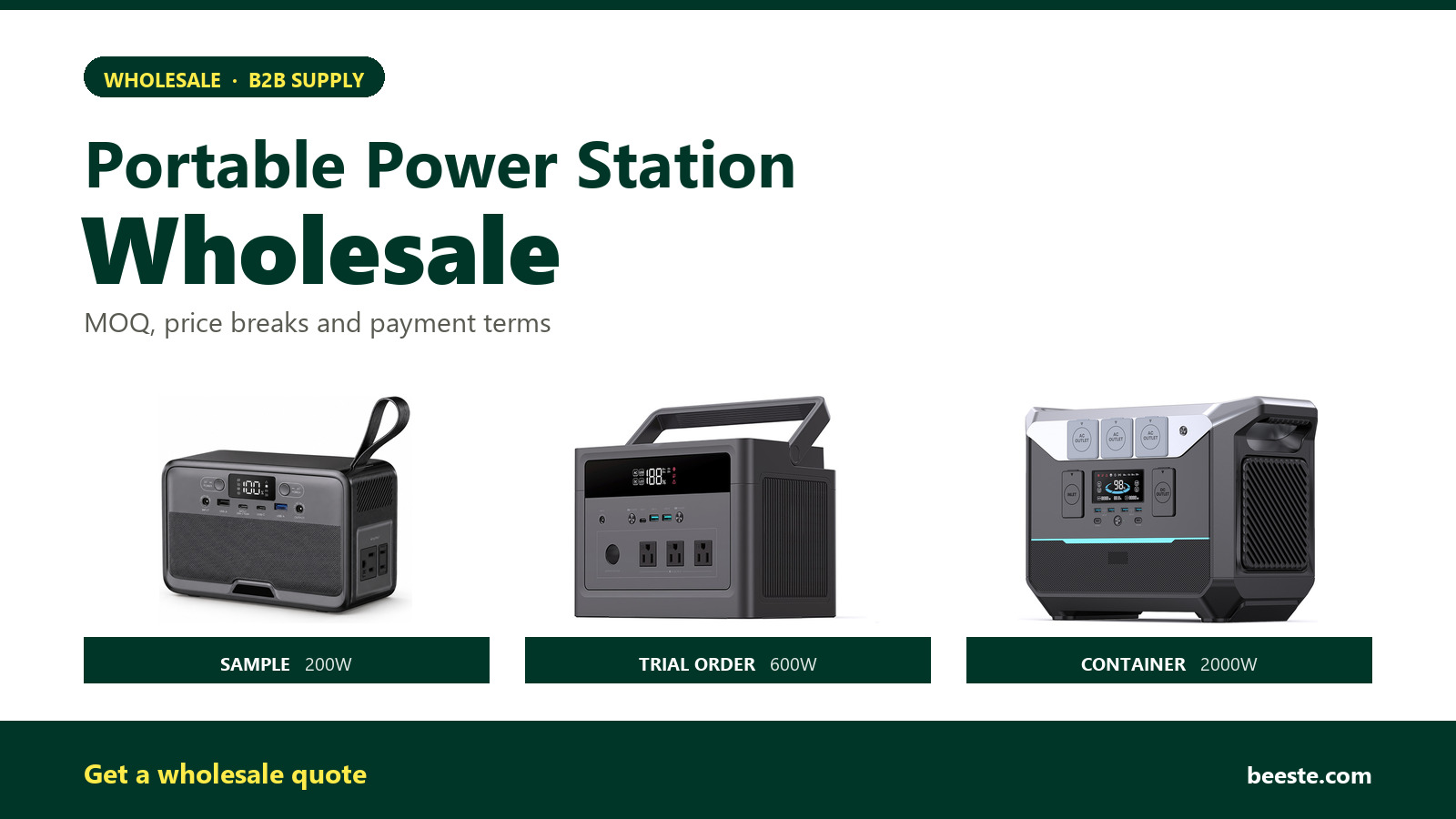
Read the second column against your nameplate LRA and the third against your running watts. The 600W portable power station suits a compact or mid-size box with a modest compressor. The 1500W portable power station covers most household refrigerators and leaves room for a second small load. The 2000W portable power station is the one to specify when the compressor is large, the ambient temperature is high, or the refrigerator must run alongside other equipment.
A worked example, with the arithmetic shown
Take a refrigerator drawing 150 W running and needing roughly three times that to start, and the 1920 Wh model. Usable energy: 1920 × 0.85 = 1632 Wh. At 150 W that is about 10.9 hours of compressor run time. A refrigerator in a temperate room runs at roughly one-third duty cycle, so the same pack delivers about 30 hours of wall-clock cooling; in a hot room the duty cycle rises and the figure falls. Starting load is about 450 W, comfortably inside the documented peak. A large side-by-side needing 900–1200 W at start is still inside the 2400 W over-power window, but now close enough that the time limit becomes the deciding factor.
Frequently asked
Can a 600 W station start a refrigerator?
Sometimes, and only if the compressor is small. The 600 W model sustains ≥650 W for 20 seconds and ≥1200 W for 200 milliseconds. A compact box whose start surge stays inside that window will run; a full-size refrigerator will usually trip it, and the failure looks like the station switching off rather than an error message.
Does sine wave output matter for a refrigerator?
Yes for the motor. A modified square wave forces extra heating in the winding, and a compressor is the least forgiving load in a house. Check that the model you specify lists sine wave output in its AC specification — the NEO2000 sheet does. Do not assume it across a range; confirm it per model.
How long will a station run a refrigerator overnight?
Multiply capacity by 0.85, divide by running watts, then divide by the duty cycle. With 1152 Wh and a 150 W refrigerator the continuous figure is about 6.5 hours; at one-third duty cycle that is roughly 19 hours of cooling. Both are calculated, not tested, and the duty cycle is the assumption you should replace with your own measurement.
Can I add a second appliance at the same time?
Only inside the continuous rating. Add the running watts of everything on together, keep the total below rated AC output, and remember each motor start is a separate surge event. Two compressors starting at once is a harder case than either alone.
If you are sizing a shipment rather than one installation, the same three conditions apply per unit, but the model mix matters more than headline wattage. Our team can work through the load list with you, including duty cycles typical for the destination market — send us the appliance list and we will return a sizing table rather than a recommendation. For models outside the three above, see the full range of portable power stations.
Portable Power Station Manufacturers China: The Cluster, Not the Catalogue
Related Article