



NEO3600 Portable Power Station: 3600W, 2304Wh LiFePO4, 3 AC Outlets
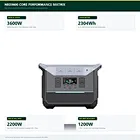
The NEO3600 is a 3600 W / 2304 Wh LiFePO4 portable power station with a 5000 W three-second surge, three 230 V AC outlets, 2200 W AC charging and 1200 W solar input. It is sized for loads that are heavy but short — a pump, a microwave, a site tool — not for multi-day off-grid living.
What 3600 W actually runs
One heavy appliance at a time, plus small loads on the USB ports. This table is about the continuous rating; run time is in section five.
| Load | Running draw | Fits 3600 W |
|---|---|---|
| Microwave | 1,500 W | Yes |
| Coffee machine | 1,200 W | Yes |
| Circular saw | 1,600 W | Yes — start-up inside the 5000 W surge |
| Well pump | 900 W | Yes |
| Kettle | 3,000 W | Yes |
| Induction hob | 3,500 W | Yes, close to the ceiling |
| Fridge or freezer | 150 W running | Yes — cycles, so average draw is lower |
| MIG welder | 4,000 W and up | No — above the continuous rating |
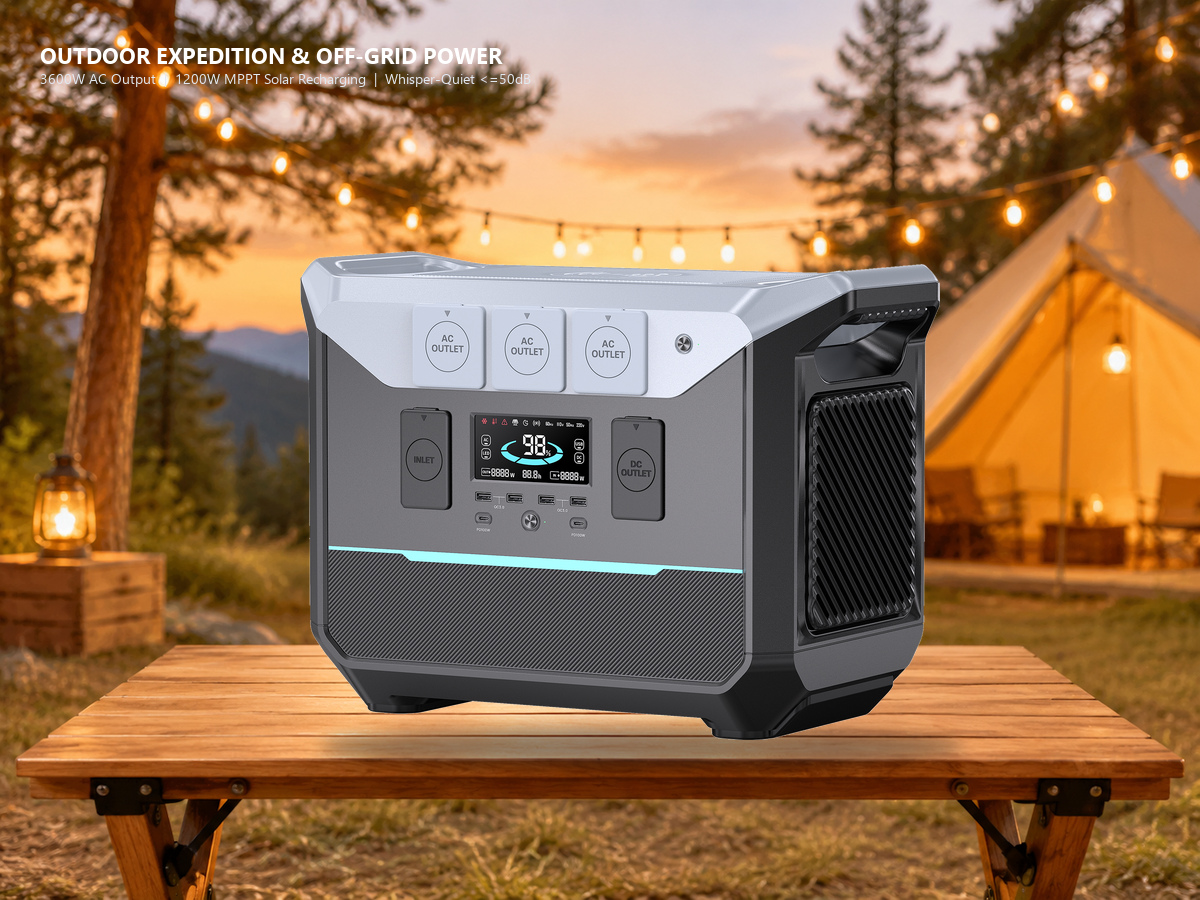
3600 W continuous, 5000 W for three seconds
A motor pulls several times its rated wattage at the moment of start, so a unit that only delivers its continuous rating trips on the start rather than on the load. The NEO3600 holds 5000 W for three seconds, enough for one motor in this class.
| Rating | Value |
|---|---|
| Rated AC output | 3600 W continuous |
| Surge | 5000 W for 3 seconds |
| Over-power behaviour | Above 3700 W ± 100 W it limits current instead of cutting immediately |
| Inverter efficiency | ≥90 % at full load |
| Output | Pure sine wave, 230 Vac, 200–240 V, 15.6 A, 50/60 Hz ±5 Hz |
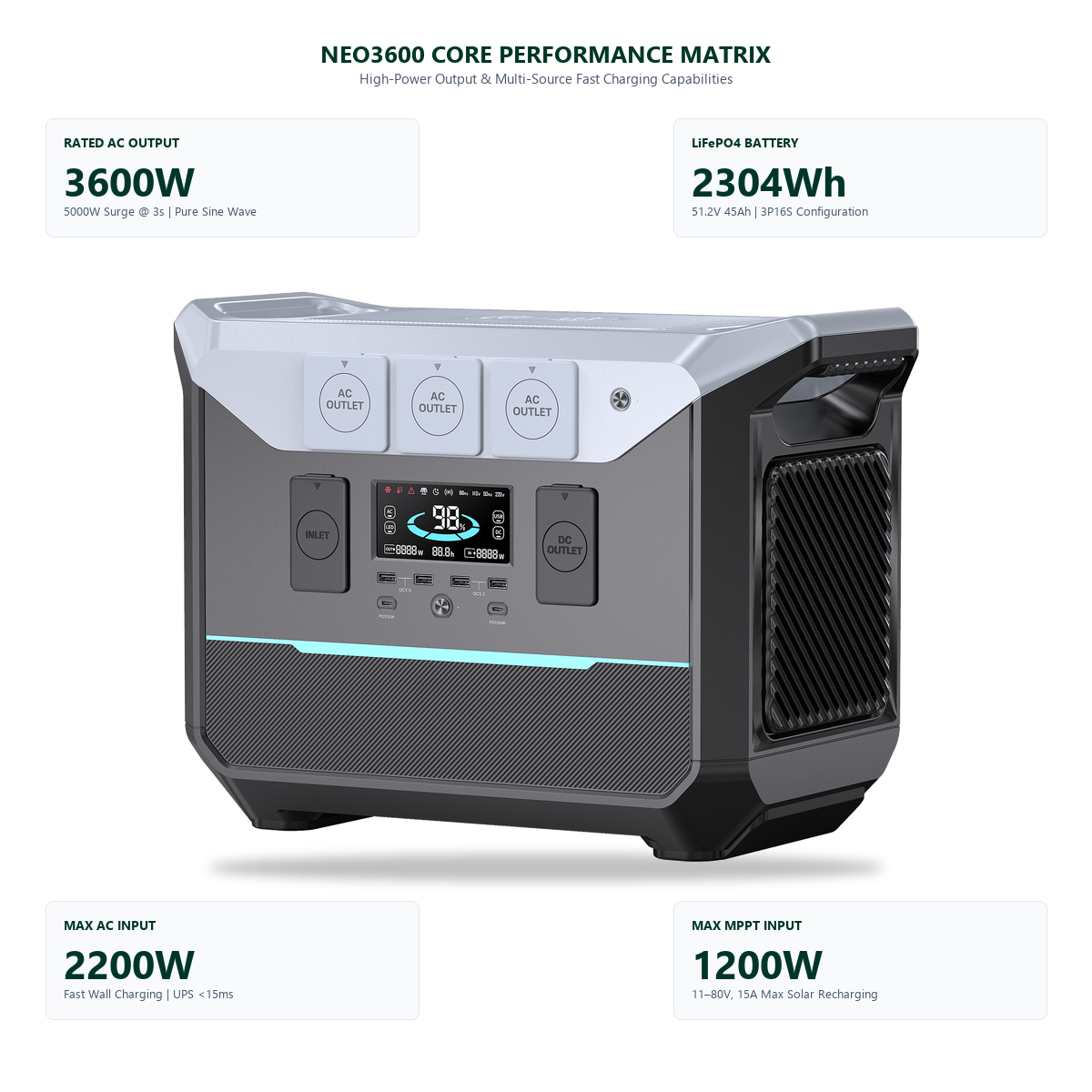
Two ways to recharge: 2200 W from the wall, 1200 W from solar
Two documented inputs. We publish no charge time: the sheet gives input power, not duration, so any “X hours to full” claim on this unit is extrapolated.
| Input | Specification |
|---|---|
| AC charging | 230 Vac, 200–240 V, 50/60 Hz (47–63 Hz), max 2200 W, 43 A |
| Solar (MPPT) | 11–80 V, max 15 A, max 1200 W, adaptive, over-temperature cut-off ≥100 °C |
| UPS transfer | Under 15 ms — ride-through, not an installed UPS |
| Standby draw | Under 5 W in float; under 20 W with the inverter on and no load |
| Charge cut-off | 58.4 V, termination current 0.01 C |
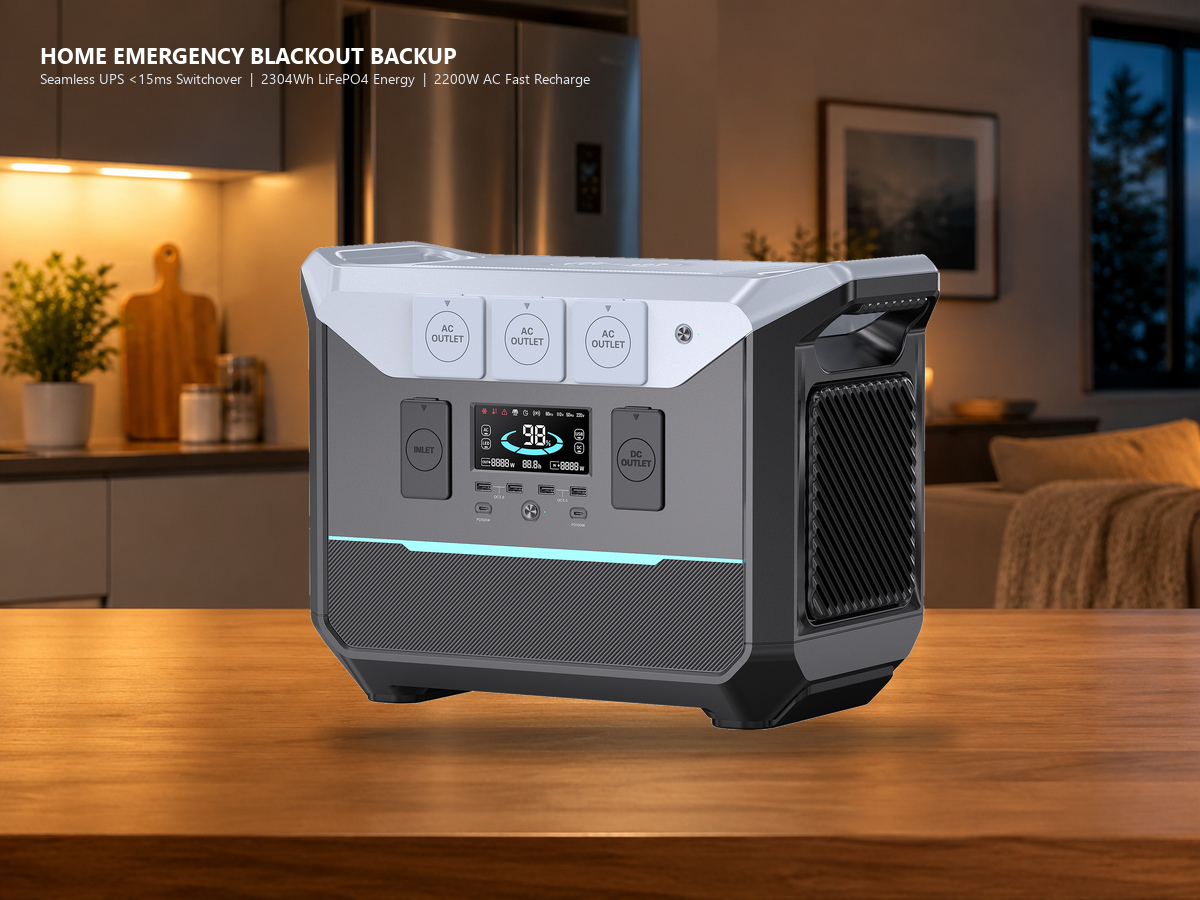
Every port on the panel
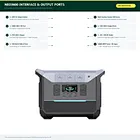
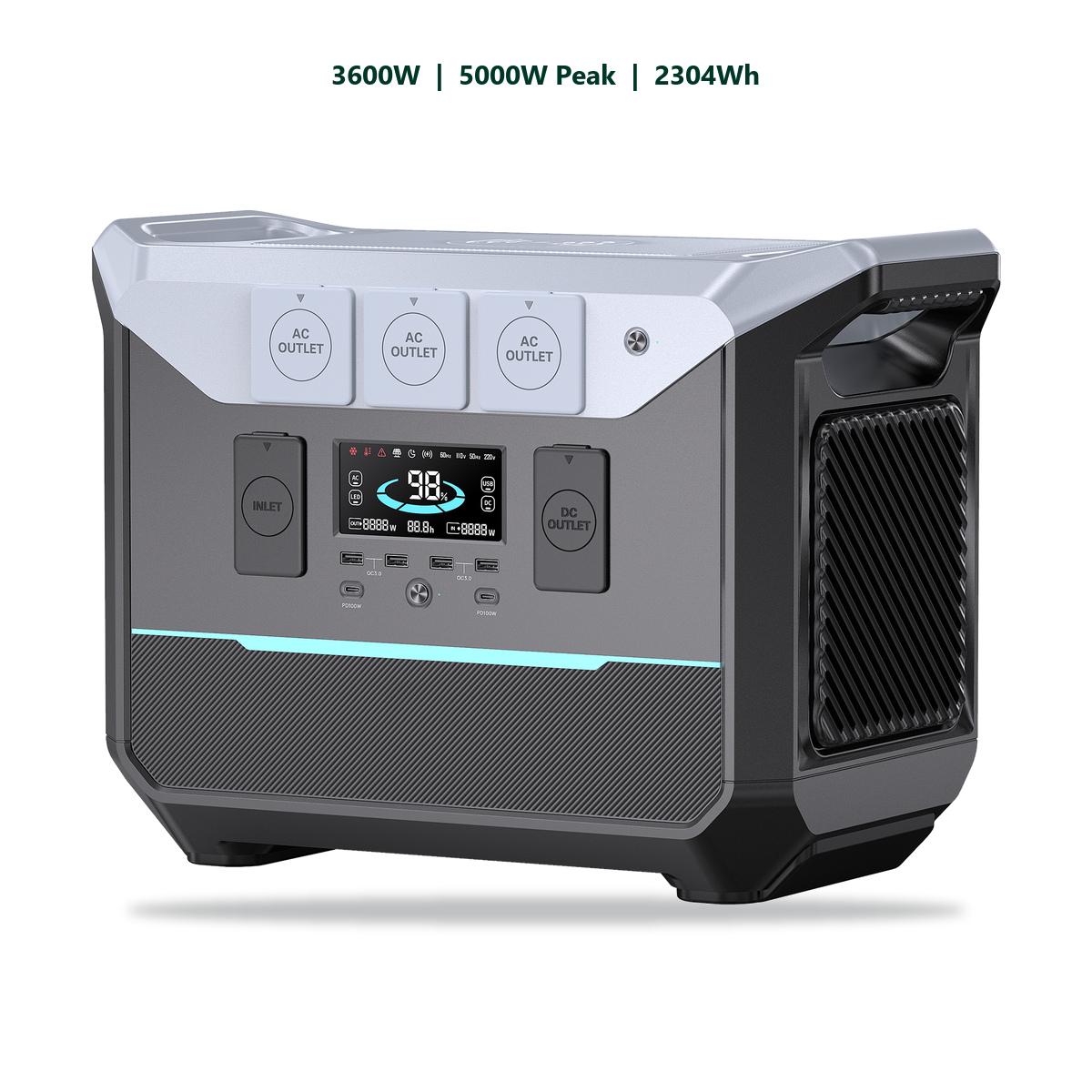
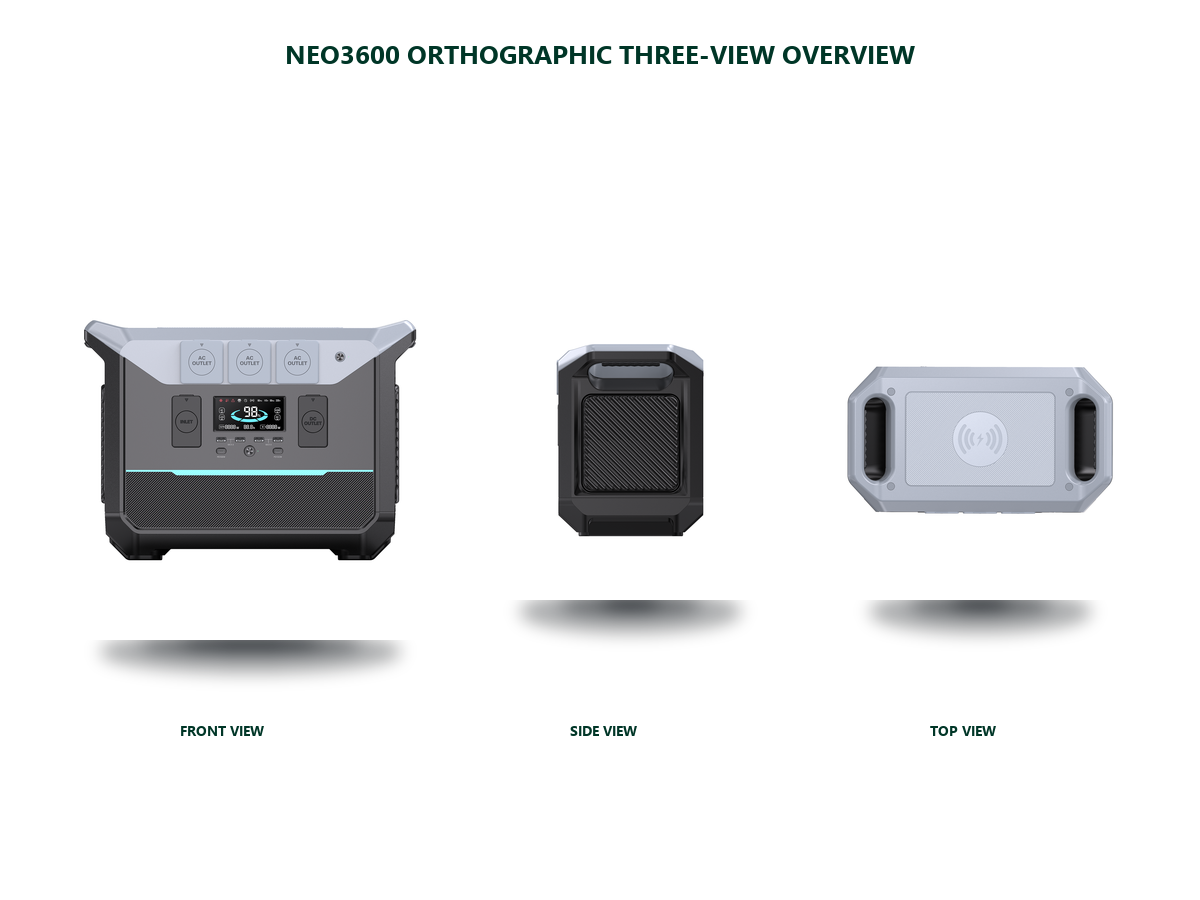
Three AC outlets, six USB ports, one 12 V socket and the solar input.
| Port | Rating | What it is for |
|---|---|---|
| AC outlets ×3 | 230 Vac, 15.6 A total | Anything with a mains plug, within 3600 W |
| USB-A1 / A2 | QC3.0, 18 W max | Phones, tablets, accessories |
| USB-A3 / A4 | 5 V / 2.4 A, 12 W max | Sensors, lights, slow charging |
| USB-C1 | PD, 100 W max (20 V / 5 A) | Laptops, cameras, drones |
| USB-C2 | 27 W max | Phones, tablets, smaller laptops |
| DC socket | 12 V / 10 A, over-current ≥11 A | 12 V fridges, fans, lights, radio |
| Solar input | XT60, 11–80 V, 15 A, 1200 W | Folding panels |
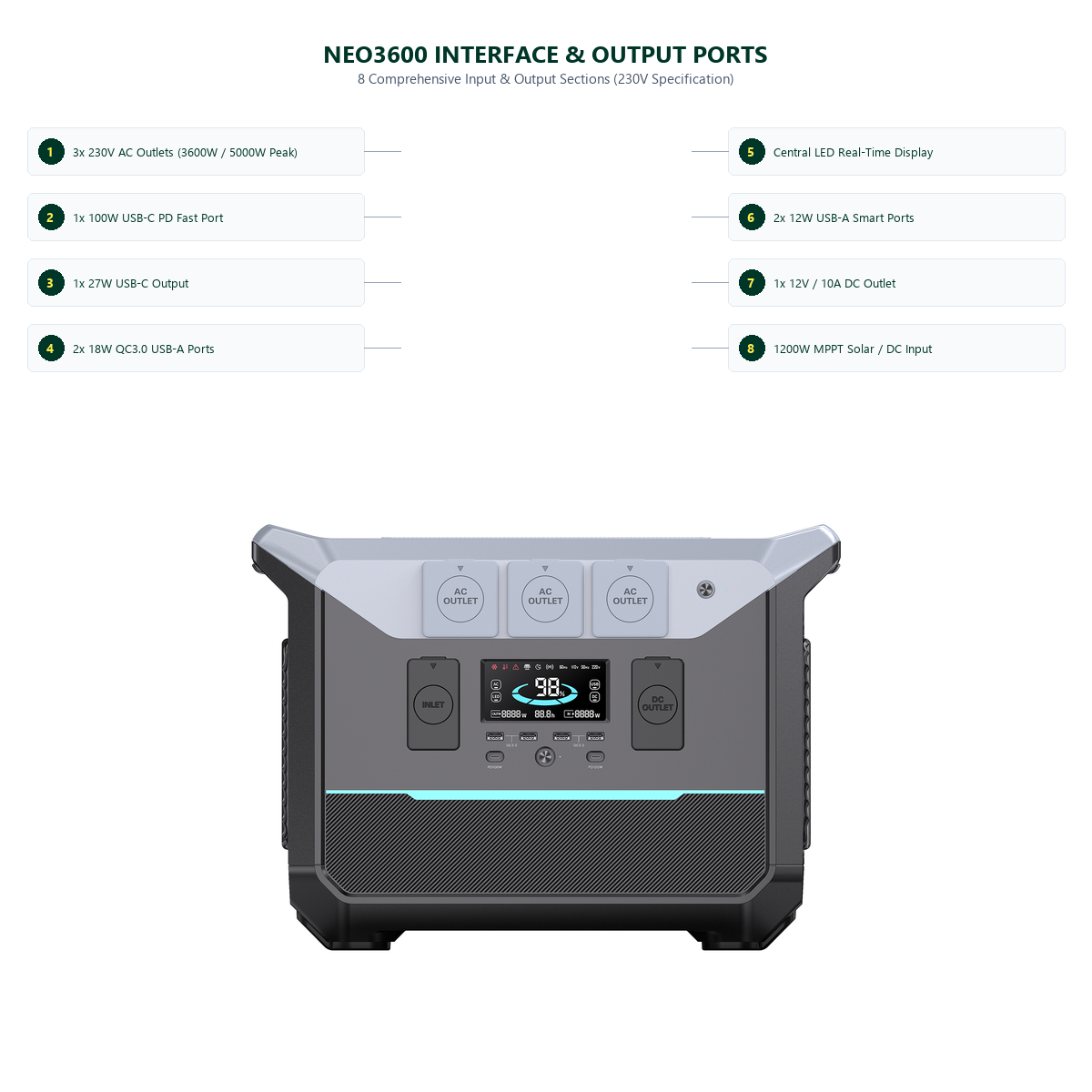
Run time for your own load
Two derating notes apply to AC loads: usable output is about 95 % of rated capacity, and inverter efficiency is at least 90 % at full load. For a mains load the figure is (2304 Wh × 0.95 × 0.90) ÷ watts. DC loads skip the inverter, so only the 95 % note applies.
| Load | Path | Calculated run time |
|---|---|---|
| 1,500 W appliance | AC | about 1.3 hours |
| 1,200 W appliance | AC | about 1.6 hours |
| 900 W appliance | AC | about 2.2 hours |
| 300 W load | AC | about 6.6 hours |
| 100 W load | AC | about 19.7 hours |
| 100 W load | 12 V / USB | about 21.9 hours |
Calculated, not measured, assuming constant load. A fridge cycles, so its real run time exceeds the constant-load arithmetic.
Noise, heat and indoor use
Forced air through two fans with automatic speed control: quiet at low load, not silent at full load.
| Item | Specification |
|---|---|
| Running noise | ≤50 dB (measurement distance not stated in the specification) |
| Ingress protection | IP21 — drip-proof, not weatherproof; do not leave it in rain |
| Cooling | Forced air, 2 fans, automatic speed control |
| Charging ambient | 0–45 °C |
| Discharging ambient | −10–45 °C |
| Cell temperature | Charge 0–55 °C; discharge −10–75 °C |
| Humidity | 25–85 % RH, no condensation |
| Storage | 12 months −10–20 °C, 3 months −10–40 °C, 1 month −10–60 °C, kept at 45–55 % charge |
Certification wording, and what it does not mean
Designed with reference to FCC, UN38.3, UL 2743, PSE, SP188, MSDS and METI. The charger is designed with reference to PSE, UL and CE, and the unit is produced in reference to RoHS.
That is a design statement, not a certification mark, and not an NRTL listing. There is no UL or ETL mark on the product. If your compliance team needs one, say so before ordering — it is a different document trail.
Specifications
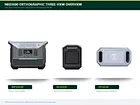
Everything the specification sheet fixes, in one place. Weight and dimensions are not listed because they are not fixed in the current revision.
| Item | Specification |
|---|---|
| Model | NEO3600 |
| Rated power | 3600W |
| Peak power | 5000W @ 3s |
| Rated energy | 2304Wh |
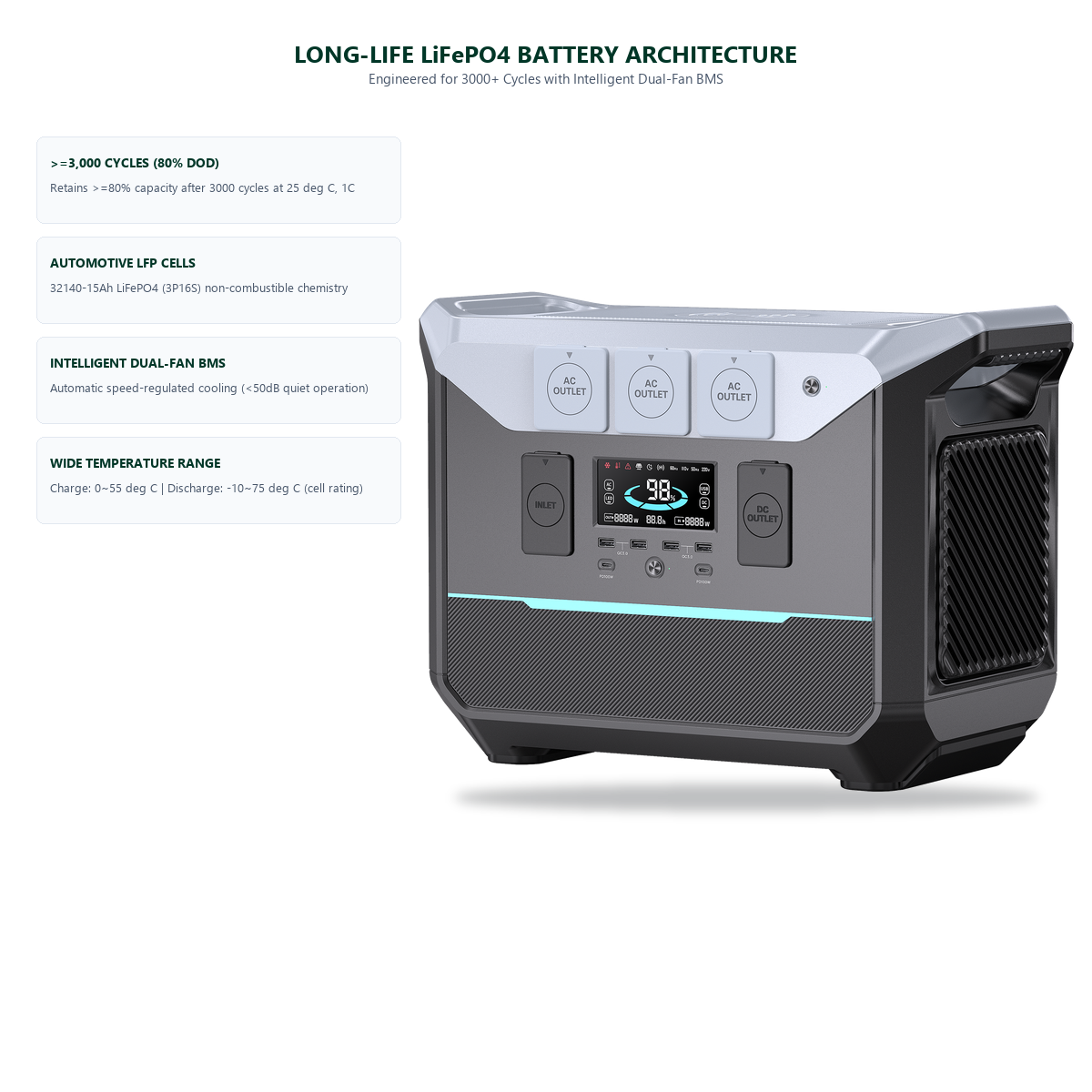
| Battery / cell | LiFePO4, LFP32140-15Ah, 3P16S |
| Battery voltage / capacity | 51.2V / 45Ah total, 15Ah per cell |
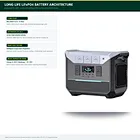
| Cycle life | ≥3000 cycles (80% DOD, 25℃, 1C, to 80% capacity) |
| Cell operating temperature | Charge 0–55℃; discharge −10–75℃ |
| BMS current | 45A charge / 90A discharge |
| AC output | Pure sine wave, 230Vac, 200–240V, 15.6A, 50/60Hz ±5Hz |
| AC outlets | 3 × 230V AC |
| Over-power protection | >3700W ±100W (current-limiting mode) |
| Inverter efficiency | ≥90% at full load |
| AC charging input | 230Vac, 200–240V, max 2200W, 43A, 47–63Hz |
| UPS switchover | <15 ms |
| No-load draw | <5W (float) / <20W (inverter on) |
| Solar input (MPPT) | 11–80V, max 15A, max 1200W, adaptive |
| USB | 6 total: 2× USB-A QC3.0 18W, 2× USB-A 5V/2.4A 12W, 1× USB-C PD 100W, 1× USB-C 27W |
| DC output | 12V/10A cigarette port, over-current ≥11A |
| LED light | 3W, steady / medium / strobe / SOS |
| Display | LED segment screen: AC V/Hz/W/time, DC W/time, charge W/time, fault codes, battery state |
| Noise | ≤50dB |
| Ingress protection | IP21 |
| Cooling | Forced air, 2 fans, automatic speed control |
| Operating humidity | 25%–85% RH, non-condensing |
| Shipping state of charge | 20%–60% |
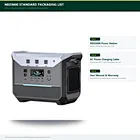
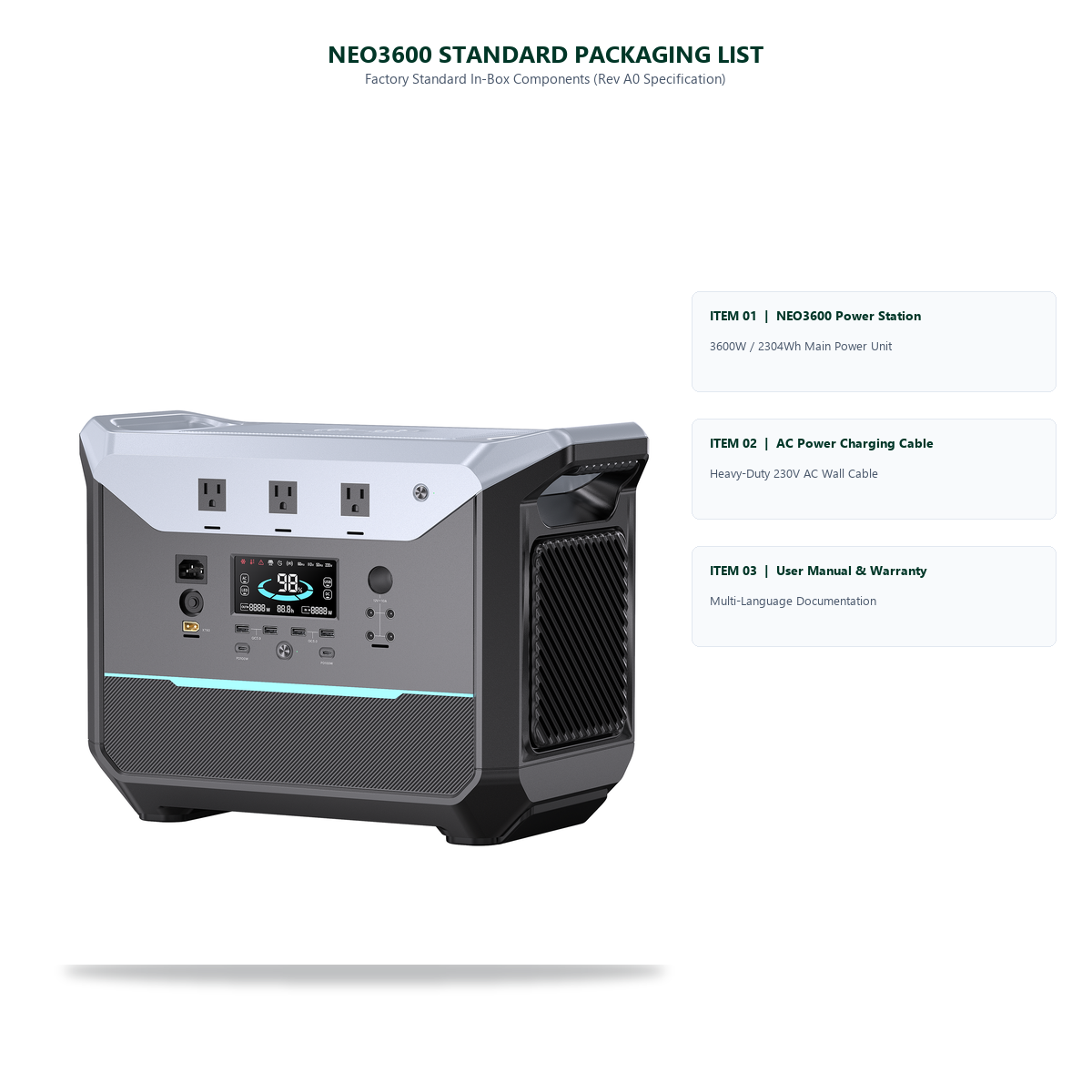
| In the box | Unit ×1, AC power cable ×1, manual ×1 |
Where the limits are
- Charge input is fixed at 2200 W. No adjustable level. On 230 V that is roughly 9.6 A, so on a 16 A circuit shared with a kettle or heater the breaker limits you, not the power station.
- 2304 Wh at 3600 W means short, heavy cycles. This is a unit for a pump, a tool or an outage, not for running a house for days. For multi-day autonomy a larger battery is the correct purchase.
- Plug type and output voltage are configured at order. The datasheet covers the 230 V build; 110 V builds and EU, UK or US plug types are selected when the order is placed, so confirm the configuration in the quotation. Custom configurations carry different lead times and minimum quantities from the standard build.
- Pass-through is not battery mode. With the charger connected the AC input path is 2200 W, below the 3600 W inverter rating. Size a continuous pass-through load to the input figure unless we confirm otherwise for your configuration.
Tested before it ships
What we can evidence is the protection set, the referenced standards and the box contents. We do not describe production-line test procedures: no document evidences them for this model.
| BMS protection | Threshold |
|---|---|
| Over-charge | 3.65 ± 0.025 V per cell |
| Over-charge recovery | 3.5 ± 0.025 V |
| Over-discharge | 2.8 ± 0.025 V |
| Over-discharge recovery | 2.95 ± 0.025 V |
| Discharge over-current | 150 A ± 5 A |
| Charge low-temperature cut-off | 0 °C |
| MOS over-temperature | 100 °C |
| Short circuit | Protected |
In the box: power station ×1, AC charging cable ×1, user manual ×1.
Tell us your market and we will send the documents that exist for that configuration.
FAQ
1. What can the NEO3600 actually run?
One heavy appliance at a time. 3600W continuous covers a 1,500W microwave, a 900W well pump, a 1,600W circular saw or a 1,200W coffee machine, plus small loads on the six USB ports. Add the continuous wattage of everything you plan to run at once and keep the total under 3600W.
2. Can it run a 1,500W microwave?
Yes, comfortably. A 1,500W microwave sits well inside the 3600W continuous rating, and its start-up draw is brief enough to fall within the 5000W three-second surge. The limit is simultaneous load: a microwave plus a kettle plus a heater exceeds the rating even though each one alone is fine.
3. Can it run a refrigerator?
Yes, and it is one of the better-matched loads. A domestic fridge draws 150–400W while running but two to three times that for a second when the compressor starts, which is exactly what the 5000W surge covers. Runtime depends on duty cycle rather than nameplate wattage, so calculate against average draw.
4. How long will 2304Wh last?
Divide the derated energy by your load. Rated energy is 2304Wh; the specification notes about 95% of that is usable, and inverter efficiency is at least 90% at full load. For AC loads both apply — 2304 × 0.95 × 0.90 ÷ watts — which puts a 1,500W appliance near 1.3 hours, not 1.5. DC loads on USB and 12V skip the inverter and take the 95% figure only. Fridges cycle, so real runtime exceeds continuous arithmetic.
5. Can I charge it from solar panels?
Yes. The MPPT input accepts 11–80V at up to 15A and 1200W, and adapts to the array voltage instead of requiring a fixed input. A 400W array will charge it meaningfully; a 1200W array uses the full input. Check that your panels' open-circuit voltage stays inside the 80V ceiling in cold weather.
6. How long does it take to charge?
The specification states input power, not charge time, so we will not quote hours. AC charging accepts up to 2200W and solar up to 1200W, and the two can run together. Actual time depends on your supply, the battery's state of charge and the charging curve, which slows near full.
7. Can two NEO3600 units be paralleled for more power?
No parallel or expansion port is documented in the specification, so treat it as a standalone 3600W unit. If you need more than 3600W continuous or longer runtime from one system, talk to our commercial team about the larger configurations rather than assuming two units can be combined.
8. How loud is it under load?
50dB or less. Cooling is forced air through two speed-controlled fans, so noise rises with load rather than staying constant. At 50dB it is comparable to a quiet conversation or a domestic fridge, which makes an office or a bedroom realistic; a cabinet with no airflow is not.
9. Can I use it indoors?
Yes, with ventilation. IP21 covers solid objects and vertical dripping water, so indoor and sheltered use is in scope, and rain is not. Keep the intake and exhaust clear, do not box it into a closed cabinet, and avoid condensing environments even though 25%–85% RH non-condensing is the rated range.
10. How long will the battery last?
At least 3000 cycles. The specification rates ≥3000 cycles to 80% remaining capacity at 80% depth of discharge, 25℃ and 1C. That is roughly eight years of daily full cycling, and considerably longer in backup use where the pack sits idle most of the time. LiFePO4 chemistry is the reason the figure is this high.
11. What certifications does it have?
It is designed with reference to FCC, UN38.3, UL 2743, PSE, SP188, MSDS and METI standards; the charger with reference to PSE, UL and CE; and it is produced in reference to RoHS. These are design references. Ask us for the specific document you need before ordering rather than assuming a mark is on the label.
12. Does the NEO3600 carry a UL or ETL listing?
No. The unit is designed with reference to UL 2743, and that is a design reference, not an NRTL listing or a UL mark on the product. If your project requires a UL or ETL listing, tell us at the quotation stage — it is a different certification route with its own timeline and it cannot be added after shipment.
13. What is the warranty, and can you OEM it?
Warranty terms are set per order and confirmed in the quotation, so we will not print a number here that may not match your contract. OEM and private-label programmes are available, including enclosure branding, packaging and documentation language; our commercial team confirms the minimum order quantity and lead time for your configuration.
14. How is it shipped, given the battery?
As lithium batteries under UN38.3 and SP188 provisions, with MSDS documentation. That governs how it can travel by air, sea and road, and it is why shipping documents are issued per order rather than as a generic sheet. Tell us the destination country at the quotation stage so the paperwork matches the route.
15. Can it work as a UPS for a desktop and a router?
Yes, with a caveat. In UPS mode the unit transfers in under 15 ms, fast enough that a desktop and a router ride through a mains drop without rebooting. It is not an installed UPS, though: inverter idle draw is under 20W, so continuous standby costs energy, and for always-on equipment a dedicated DC UPS is the better device.
16. Can I get it in 110V, or with a UK/EU plug?
Yes — output voltage and plug type are configured at order. This datasheet covers the 230V build; 110V builds and EU, UK or US plug types are selected when the order is placed, so confirm your configuration in the quotation. It is one voltage per unit, not a switchable dual-voltage machine.
What it runs, and for how long
Section one lists what fits the rating; section five turns that into hours. The short version: one heavy mains appliance at a time, and 2304 Wh does not stretch to days.
Who it suits
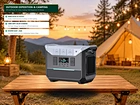
Job sites with one big tool, short outages where a pump or a fridge must keep running, and events with a known load list. A poor fit for anyone needing an installed UPS or multi-day autonomy.
Before you order
Confirm the plug configuration for your market, the start-up wattage of the motor you intend to run, and which certification documents your compliance team needs.
Related reading
TheNEO series runs from 300 W to this unit at the top. The portable power station range covers smaller formats; the STAR series and the Cubus series sit below it, and DC UPS is the right device for always-on switchover. For a mid-size home duty cycle the 1500W class unit is far smaller. To send a load list or an OEM/ODM brief, use the contact page.